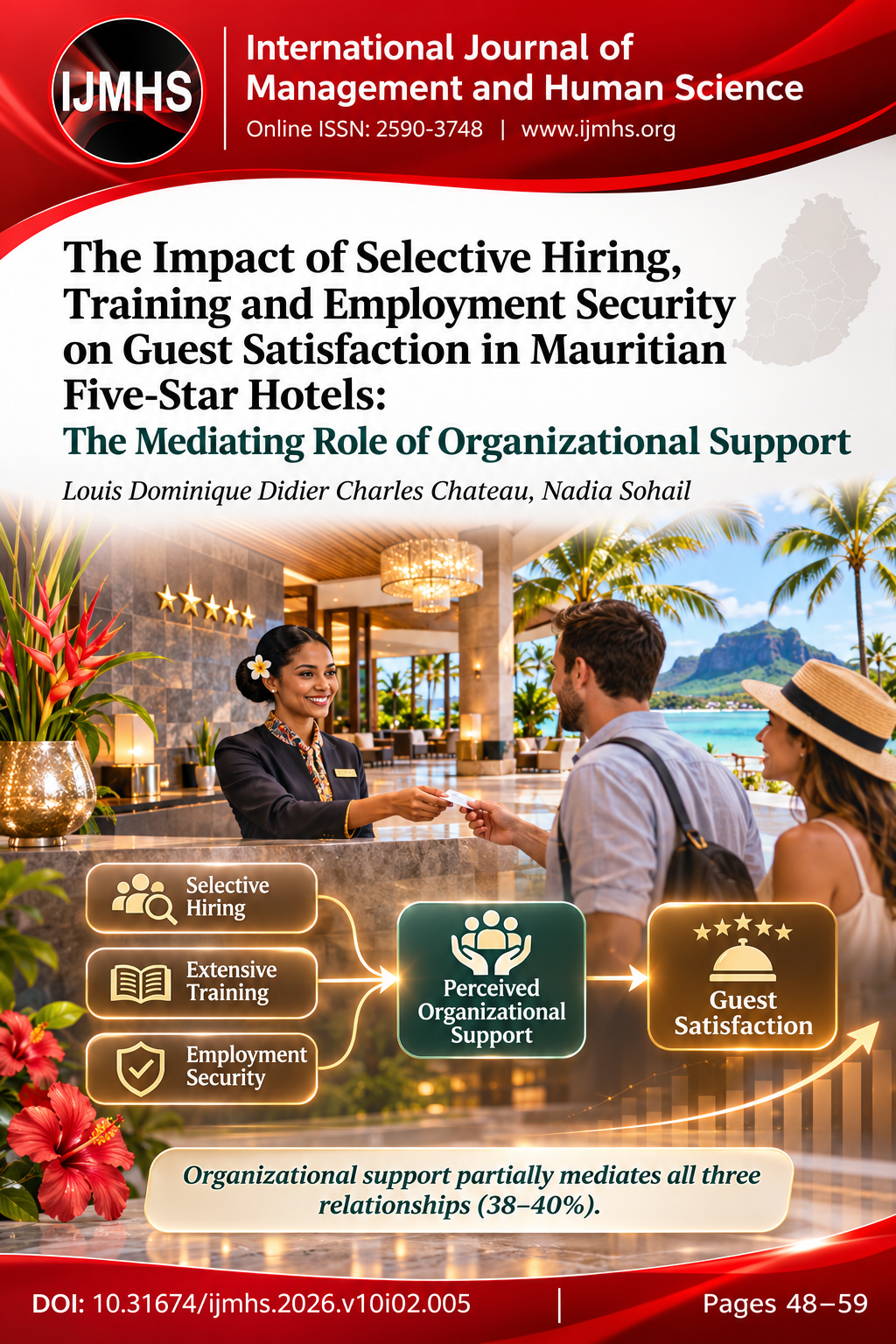
The Impact of Selective Hiring, Training and Employment Security on Guest Satisfaction in Mauritian Five-Star Hotels: The Mediating Role of Organizational Support
DOI:
https://doi.org/10.31674/ijmhs.2026.v10i02.005Abstract
Background: High-Performance Work System (HPWS) practices may shape service outcomes, but evidence on Perceived Organizational Support (POS) in Mauritian luxury hospitality is limited. Objectives: This study examined associations among selective hiring, extensive training, employment security, POS and employee-perceived guest satisfaction and tested whether POS mediates these associations. Methods: The study employed a cross-sectional, sequential explanatory mixed-methods design, combining an employee survey (n = 380) from six Mauritian five-star hotels, analyzed using PLS-SEM with 5,000 bootstrap samples, and thematic analysis of 13 interviews (9 HR managers or supervisors, 4 frontline employees). Survey measures were employee-reported. Results: The results show that all three HPWS dimensions - selective hiring, extensive training and employment security - have significant direct effects on guest satisfaction, and POS partially mediates about 38 to 40% of these effects. Extensive training was the strongest antecedent of POS (β = 0.312), followed by selective hiring (β = 0.241) and employment security (β = 0.198). POS was the strongest single predictor of guest satisfaction (β = 0.389). The qualitative themes explain five contextual themes that underpin the psychological mechanisms behind these statistical relationships (signal value of selective hiring, training as relational investment, fragility of employment security in a SIDS context, experiential gestalt of POS and contextual enablers/barriers to POS) and the Mauritian luxury hospitality environment. Conclusion: HPWS practices and POS are positively associated with employee-perceived guest satisfaction, and POS partially mediated each HPWS association.
Keywords:
Guest Satisfaction, High-Performance Work Systems, Luxury Hospitality, Perceived Organisational Support, Small Island Developing StatesDownloads
References
AXYS Group. (2023, August 26). Tourism revival in Mauritius according to an AXYS report. https://maurice-info.mu/2023/08/26/renaissance-du-tourisme-a-maurice-selon-un-rapport-daxys.html
Barney, J. (1991). Firm resources and sustained competitive advantage. Journal of Management, 17(1), 99–120. https://doi.org/10.1177/014920639101700108
Bettencourt, L. A., & Brown, S. W. (1997). Contact employees: Relationships among workplace fairness, job satisfaction and prosocial service behaviors. Journal of Retailing, 73(1), 39–61. https://doi.org/10.1016/S0022-4359(97)90014-2
Borucki, C. C., & Burke, M. J. (1999). An examination of service-related antecedents to retail store performance. Journal of Organizational Behavior, 20(6), 943–962. https://doi.org/10.1002/(SICI)1099-1379(199911)20:6%3C943::AID-JOB976%3E3.0.CO;2-9
Bos-Nehles, A., Bondarouk, T., & Nijenhuis, K. (2023). Innovative work behaviour in knowledge-intensive industries: The role of high-performance work systems. International Journal of Human Resource Management, 34(2), 318–351. https://doi.org/10.1080/09585192.2020.1869051
Braun, V., & Clarke, V. (2023). Thematic analysis: A practical guide (2nd ed.). SAGE Publications.
Chouhan, V. S. (2025). Linking high-performance work system and empowering leadership with hospitality employees' job outcomes: Work engagement as mediator. Journal of Human Resources in Hospitality & Tourism, 25(2), 373–402. https://doi.org/10.1080/15332845.2025.2588524
Cohen, J. (1988). Statistical power analysis for the behavioral sciences (2nd ed.). Lawrence Erlbaum Associates. https://doi.org/10.4324/9780203771587
Creswell, J. W., & Creswell, J. D. (2023). Research design: Qualitative, quantitative, and mixed methods approaches (6th ed.). SAGE Publications.
Delery, J. E., & Doty, D. H. (1996). Modes of theorizing in strategic human resource management: Tests of universalistic, contingency, and configurational performance predictions. Academy of Management Journal, 39(4), 802–835. https://doi.org/10.5465/256713
Dorta-Afonso, D., González-de-la-Rosa, M., García-Rodríguez, F. J., & Romero-Domínguez, L. (2021). Effects of high-performance work systems (HPWS) on hospitality employees’ outcomes through their organizational commitment, motivation, and job satisfaction. Sustainability, 13(6), Article 3226. https://doi.org/10.3390/su13063226
Eisenberger, R., Huntington, R., Hutchison, S., & Sowa, D. (1986). Perceived organizational support. Journal of Applied Psychology, 71(3), 500–507. https://doi.org/10.1037/0021-9010.71.3.500
Eisenberger, R., Rockstuhl, T., Shoss, M. K., Erdogan, B., & Kaplan, S. (2023). Is work central to employees' identity? Reciprocation of perceived organisational support by identification with the organisation. Journal of Applied Psychology, 108(4), 621–638. https://doi.org/10.1037/apl0001043
Elshaer, I. A., Azazz, A. M. S., Kooli, C., & Fayyad, S. (2023). Unravelling the effect of human resource management practices on hotel performance: The mediating role of employee engagement. Administrative Sciences, 13(2), Article 48. https://doi.org/10.3390/admsci13020048
Faul, F., Erdfelder, E., Buchner, A., & Lang, A.-G. (2009). Statistical power analyses using G*Power 3.1: Tests for correlation and regression analyses. Behavior Research Methods, 41(4), 1149–1160. https://doi.org/10.3758/BRM.41.4.1149
Jiang, K., Lepak, D. P., Hu, J., & Baer, J. C. (2012). How does human resource management influence organizational outcomes? A meta-analytic investigation of mediating mechanisms. Academy of Management Journal, 55(6), 1264–1294. https://doi.org/10.5465/amj.2011.0088
Kandampully, J., Zhang, T. C., & Bilgihan, A. (2023). Service excellence in hospitality: Conceptualisation and empirical evidence. International Journal of Contemporary Hospitality Management, 35(3), 933–952. https://doi.org/10.1108/IJCHM-04-2022-0487
Kehoe, R. R., & Wright, P. M. (2023). The impact of high-performance human resource practices on employees' attitudes and behaviours. Journal of Management, 49(3), 366–391. https://doi.org/10.1177/01492063211047430
Kruesi, J., & Bazelmans, J. (2022). Resource-based view and competitive advantage in island tourism destinations. Tourism Geographies, 24(2), 345–368. https://doi.org/10.1080/14616688.2021.1959571
McManus, H., Dundon, T., & Lavelle, J. (2025). "Workin' for a livin": Mediating the role of perceived support, work engagement, and organizational citizenship behavior in the hospitality sector. International Journal of Hospitality Management, 126, Article 103983, 1–11. https://doi.org/10.1016/j.ijhm.2024.103983
Ngwa, M. S., & Bayram, P. (2026). Does perceived organizational support lead to organizational citizenship behavior and turnover intention in hotel industry? The indirect roles of work–life satisfaction and employee resilience. Humanities and Social Sciences Communications, 13(1), Article 645, 1–12. https://doi.org/10.1057/s41599-025-06443-x
Radović, N., Vujko, A., & Stanišić, N. (2025). Digital hospitality as a socio-technical system: Aligning technology and HR to drive guest perceptions and workforce dynamics. World, 6(4), Article 134. https://doi.org/10.3390/world6040134
Ringle, C. M., Wende, S., & Becker, J.-M. (2024). SmartPLS 4. SmartPLS GmbH. https://www.smartpls.com
Singh, R. (2025). High-performance work practices and Generation Y employee engagement: A pathway to innovation and retention. Employee Relations, 47(6), 841–861. https://doi.org/10.1108/ER-12-2024-0748
Snell, S. A., & Dean, J. W. (1992). Integrated manufacturing and human resource management: A human capital perspective. Academy of Management Journal, 35(3), 467–504. https://doi.org/10.5465/256404
Soper, D. S. (2023). A-priori sample size calculator for structural equation models [Software]. https://www.danielsoper.com/statcalc
Statistics Mauritius. (2025). Population and vital statistics: Republic of Mauritius, January–June 2025. https://statsmauritius.govmu.org/Pages/Statistics/ESI/Population/Pop_Vital_Jan-Jun25.aspx
Sun, L. Y., Aryee, S., & Law, K. S. (2007). High-performance human resource practices, citizenship behaviour, and performance: A longitudinal study. Academy of Management Journal, 50(3), 558–577. https://doi.org/10.5465/AMJ.2007.25591766
Wang, C.-J., & Tsai, C.-H. (2026). Employee-centric HPWSs: Building sustainable hospitality through social exchange, empowerment, LMX, and TMX. Sustainability, 18(3), Article 1623. https://doi.org/10.3390/su18031623
Yan, Z., Zhang, Z., & Choo, W. C. (2024). What does the past mean for the future? A meta-analysis of perceived organizational support in hospitality and tourism. Journal of Hospitality and Tourism Management, 59, 127–138. https://doi.org/10.1016/j.jhtm.2024.04.004
Published
How to Cite
Issue
Section
License
Copyright (c) 2026 International Journal of Management and Human Science (IJMHS)

This work is licensed under a Creative Commons Attribution-NonCommercial-NoDerivatives 4.0 International License.