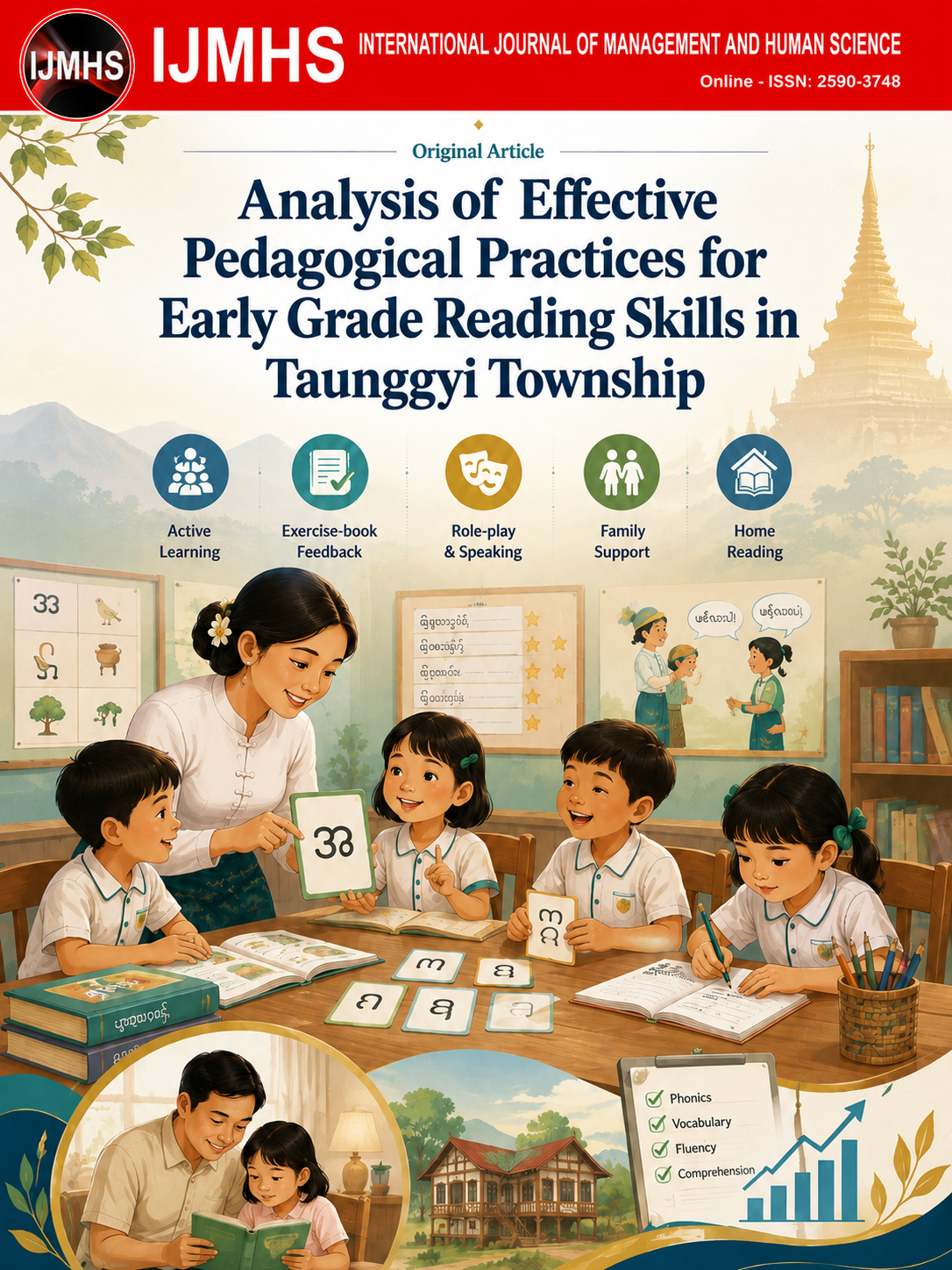
Analysis of Effective Pedagogical Practices for Early Grade Reading Skills in Taunggyi Township
DOI:
https://doi.org/10.31674/ijmhs.2026.v10i02.001Abstract
Background: Primary school students continue to struggle with early reading skills in Myanmar. There is limited empirical evidence on effective pedagogical practices in improving reading achievement in Taunggyi township. Objectives: The objective of this study was to investigate the effect of pedagogical practices on the early grade reading skills of proficient readers in Grades 1 to 3 in Taunggyi Township, Myanmar. The study adopted a cross-sectional quantitative survey design. Methods: Data were collected from 300 students selected through a two-stage random sampling procedure from 10 primary schools representing different levels of remoteness. Data were collected from students, teachers, and parents through structured questionnaires, and students’ reading ability was assessed by means of the Early Grade Reading Assessment (EGRA). The data were analyzed using the Statistical Package for Social Sciences (SPSS) version 27. Descriptive statistics and multiple regression analysis were used to investigate the relationships between pedagogical practices and reading achievement. Results: The results indicated that compound word writing activities, exercise book marking, role-play activities, adult help with homework, and adult readers in the home were positive predictors of reading performance among proficient readers. Students attending non-remote schools, female students, and students who spoke Myanmar at home had significantly higher reading scores. Conversely, the more children participated in repeated word-drilling activities and played with words, the poorer their reading achievement was. Conclusion: Results demonstrated the significance of active learning strategies, meaningful feedback, family support, and appropriate instructional strategies in improving early grade reading skills among proficient readers in Taunggyi Township, Myanmar.
Keywords:
Early Grade Reading Skills, Pedagogical Practices, Proficient Readers, Primary EducationDownloads
References
Aung, N. A. Z., & Kyi, K. S. (2026). The effect of educational input on early grade reading skills in Taunggyi Township. Journal of Multidisciplinary Research for SMET (JMR-SMET), 2(1), 1–11. https://doi.org/10.64297/jmrsmet.v2i1.34
Australian Council for Educational Research (ACER). (2021, September). Southeast Asia Primary Learning Metrics 2019 (SEA-PLM): Myanmar national report. UNESCO International Institute for Educational Planning. https://www.seaplm.org/images/Publication/Myanmar_Report/SEA-PLM_2019_National_Results_-_Myanmar_report_English.pdf
Black, P., & Wiliam, D. (1998). Assessment and classroom learning. Assessment in Education: Principles, Policy & Practice, 5(1), 7–74. https://doi.org/10.1080/0969595980050102
Boakye, N. A. (2021). Using role play and explicit strategy instruction to improve first-year students' academic reading proficiency. Reading & Writing, 12(1), 1-12. https://doi.org/10.4102/rw.v12i1.285
Bus, A. G., Van Ijzendoorn, M. H., & Pellegrini, A. D. (1995). Joint book reading makes for success in learning to read: A meta-analysis on intergenerational transmission of literacy. Review of Educational Research, 65(1), 1-21. https://doi.org/10.3102/00346543065001001
Fogarty, E. A. (2006). Teachers’ use of differentiated reading strategy instruction for talented, average, and struggling readers in regular and SEM-R classrooms [Doctoral dissertation, University of Connecticut]. DigitalCommons@UConn. https://digitalcommons.lib.uconn.edu/dissertations/AAI3234303
Gobana, J. A. (2025). Investigating quality education in mother tongue: Ensuring children’s rights to access and equity schooling. Cogent Education, 12(1), 2545617. https://doi.org/10.1080/2331186x.2025.2545617
Gough, P. B., & Tunmer, W. E. (1986). Decoding, reading, and reading disability. Remedial and Special Education, 7(1), 6–10. https://doi.org/10.1177/074193258600700104
Hanushek, E. A., & Woessmann, L. (2009). Schooling, cognitive skills, and the Latin American growth puzzle (IZA Discussion Paper No. 4576). Institute for the Study of Labor (IZA). https://doi.org/10.3386/w15066
Hattie, J. (2009). The black box of tertiary assessment: An impending revolution. In L. H. Meyer, S. Davidson, H. Anderson, R. Fletcher, P. M. Johnston, & M. Rees (Eds.), Tertiary assessment and higher education student outcomes: Policy, practice and research (pp. 259–275). Ako Aotearoa. https://findanexpert.unimelb.edu.au/scholarlywork/333618-the-black-box-of-tertiary-assessment--an-impending-revolution
Jacob, B. A., & Lefgren, L. (2004). The impact of teacher training on student achievement: Quasi-experimental evidence from school reform efforts in Chicago. Journal of Human Resources, 39(1), 50-79. https://doi.org/10.2307/3559005
Ji, G. X., Chan, P. W. K., McCormick, A., Won, M., Ali, S., Jimmy, M., Gulfan, V. G., Faamanatu-Eteuati, N., Suaalii, T. F., Chesal, K., Horihau, J., Rohoana, G. Z., Fitoo, B., & Gurung, D. (2024). Scholarly responses to ‘UNESCO global education monitoring report 2024 Pacific Technology in Education: a tool on whose terms?’. International Education Journal: Comparative Perspectives, 23(2), 154-170. https://doi.org/10.70830/iejcp.2302.20369
Mwoma, T. (2017). Children's reading ability in early primary schooling: Challenges for a Kenyan rural community. Issues in Educational Research, 27(2), 347-364. https://www.iier.org.au/iier27/mwoma.pdf
Phyu, P. E., & Siriwato, S. (2022). The progress and challenges of higher education in Myanmar. In Proceedings of the RSU International Research Conference 2022 on Social Science and Humanities, Education, and Management (pp. 50–64). Rangsit University. https://doi.org/10.14458/RSU.res.2022.95
Stanovich, K. E., Nathan, R. G., & Vala-Rossi, M. (1986). Developmental changes in the cognitive correlates of reading ability and the developmental lag hypothesis. Reading Research Quarterly, 21(3), 267. https://doi.org/10.2307/747709
UNESCO. (2023, April 20). 617 million children and adolescents not getting the minimum in reading and math. https://www.unesco.org/en/articles/617-million-children-and-adolescents-not-getting-minimum-reading-and-math
World Bank Group. (2015, June 4). Myanmar early grade reading assessment for the Yangon region. World bank Group. ACS13261-REVISED-PUBLIC-Myanmar-Early-Grade-Reading-Assessment-IDU.pdf
World Bank. (2010). Timor-Leste: An analysis of early grade reading acquisition. World Bank. https://doi.org/10.1596/27847
Xie, R., Zhang, J., Wu, X., & Nguyen, T. P. (2019). The relationship between morphological awareness and reading comprehension among Chinese children. Frontiers in Psychology, 10, 54. https://doi.org/10.3389/fpsyg.2019.00054
Zhang, D., Koda, K., & Sun, X. (2012). Morphological awareness in biliteracy acquisition: A study of young Chinese EFL readers. International Journal of Bilingualism, 18(6), 570–585. https://doi.org/10.1177/1367006912450953
Published
How to Cite
Issue
Section
License
Copyright (c) 2026 International Journal of Management and Human Science (IJMHS)

This work is licensed under a Creative Commons Attribution-NonCommercial-NoDerivatives 4.0 International License.