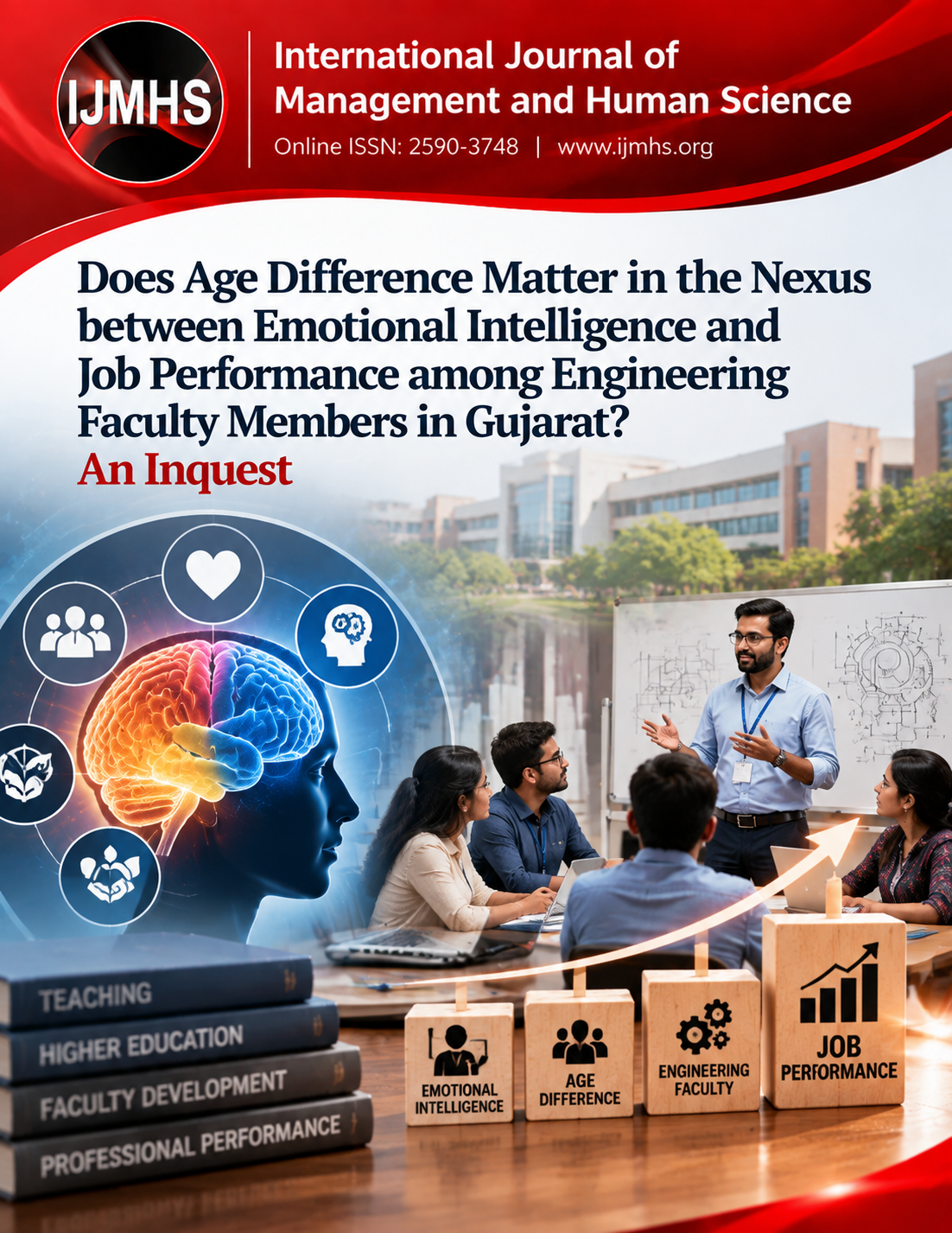
Does Age Difference Matter in the Nexus between Emotional Intelligence and Job Performance among Engineering Faculty Members in Gujarat?: An Inquest
DOI:
https://doi.org/10.31674/ijmhs.2026.v10i02.002Abstract
Background: Emotional Intelligence (EI) has gained considerable attention in both academic research and organizational practice due to its significant role in enhancing employee effectiveness and organizational outcomes. However, limited empirical evidence exists on the relationship between emotional intelligence and job performance among engineering college faculty members in the Indian higher education context. Objectives: This study aims to examine the relationship and impact of emotional intelligence on the job performance of engineering college faculty members in Gujarat state, India, and to analyze whether emotional intelligence and job performance differ across age groups. Methods: A descriptive research design was adopted, and primary data were collected through a structured questionnaire from faculty members working in engineering colleges across Gujarat. Standardized scales were used to measure emotional intelligence and job performance. The collected data were analyzed using reliability and validity tests, Exploratory Factor Analysis (EFA), Pearson correlation, regression analysis, and one-way ANOVA. Results: The findings revealed a significant positive relationship between emotional intelligence and job performance, indicating that faculty members with higher emotional intelligence tend to perform better in their professional roles. Regression analysis further confirmed that emotional intelligence significantly predicts job performance. The results also showed that emotional intelligence differs significantly across age groups, whereas job performance does not vary significantly with age. Conclusion: The study concludes that emotional intelligence is an important determinant of faculty job performance and highlights the need for higher education institutions to incorporate emotional intelligence development initiatives through faculty training and professional development programs to enhance teaching effectiveness and overall institutional performance.
Keywords:
Age Difference, Emotional Intelligence, Faculty, Higher Education, Job PerformanceDownloads
References
Aritzeta, A., Balluerka, N., Gorostiaga, A., Alonso-Arbiol, I., Haranburu, M., & Gartzia, L. (2016). Classroom emotional intelligence and its relationship with school performance. European Journal of Education and Psychology, 9(1), 1-8. https://doi.org/10.1016/j.ejeps.2015.11.001
Arteaga-Cedeno, W. L., Carbonero-Martin, M. A., Martin-Anton, L. J., Molinero-Gonzalez, P., & Valdivieso-Leon, L. (2025). How an emotional intelligence intervention programme impacts the well-being and performance of teachers of basic general education. Acta Psychologica, 253, 104739. https://doi.org/10.1016/j.actpsy.2025.104739
Corcoran, R. P., & Tormey, R. (2012). How emotionally intelligent are pre-service teachers?. Teaching and Teacher Education, 28(5), 750-759. http://dx.doi.org/10.1016/j.tate.2012.02.007
Ertekin, A. B., & Avunduk, Y. (2021). The relationship between job satisfaction and job performance: A study on sports industry. Journal of Educational Issues, 7(2), 133-145. https://doi.org/10.5296/jei.v7i2.18949
George, J. M. (2000). Emotions and leadership: The role of emotional intelligence. Human Relations, 53(8), 1027-1055. https://doi.org/10.1177/0018726700538001
Gilliani, G., & Rahardjo, M. (2023). The influence of intellectual intelligence and emotional intelligence on employee performance mediated by job satisfaction. International Journal of Application on Economics and Business, 1(3), 1782-1793. https://doi.org/10.24912/ijaeb.v1i3.1782-1793
Goleman, D. (1995). Emotional intelligence: Why it matters more than IQ. New York: Bantam.
Herrera, L., Al-Lal, M., & Mohamed, L. (2020). Academic achievement, self-concept, personality and emotional intelligence in primary education. Analysis by gender and cultural group. Frontiers in Psychology, 10, 3075. https://doi.org/10.3389/fpsyg.2019.03075
Ishak, N. M., Iskandar, I. P., & Ramli, R. (2010). Emotional intelligence of Malaysian teachers: a comparative study on teachers in daily and residential schools. Procedia-Social and Behavioral Sciences, 9, 604-612. https://doi.org/10.1016/j.sbspro.2010.12.205
Jai Bhagwan, A. (2025). Study of impact of emotional intelligence on employee performance. Journal of Marketing & Social Research, 2(2), 301-307. https://jmsr-online.com/article/study-of-impact-of-emotional-intelligence-on-employee-performance-78/
Jalalkamali, M., Ali, A. J., Hyun, S. S., & Nikbin, D. (2016). Relationships between work values, communication satisfaction, and employee job performance: The case of international joint ventures in Iran. Management Decision, 54(4), 796-814. https://doi.org/10.1108/MD-01-2015-0003
Janiarti, D., Shalahuddin, A., Fauzan, R., Hendri, M. I., & Fahruna, Y. (2025). Work-life balance, organizational support, and emotional intelligence on banking employee performance through organizational commitment. Journal of Management Science (JMAS), 8(1), 84-93. https://garuda.kemdiktisaintek.go.id/documents/detail/4676958
Joseph, D. L., & Newman, D. A. (2010). Emotional intelligence: an integrative meta-analysis and cascading model. Journal of Applied Psychology, 95(1), 54-78. https://doi.org/10.1037/a0017286
Kalaimani, G., & Miniyammal, M. (2026). Impact of emotional intelligence and quality of work life on faculty performance: An empirical study. National Research Journal of Human Resource Management, 13(1), 38–48. https://doi.org/10.5281/zenodo.20351793
Kamaruzaman, A. S., Wahab, S. R. A., Ibrahim, A., Shaari, R., Mohd Arif, L. S., & Yoo, D. (2025). Investigating the impact of emotional intelligence on operators’ job performance: A case study in Southern Malaysia. International Journal of Research and Innovation in Social Science (IJRISS), 5467-5480. https://dx.doi.org/10.47772/IJRISS.2025.909000442
Kashani, F. L., Azimi, A. L., & Vaziri, S. (2012). Relationship between emotional intelligence and educational achievement. Procedia-Social and Behavioral Sciences, 69, 1270-1275. https://doi.org/10.1016/j.sbspro.2012.12.061
Maamari, B. E., & Majdalani, J. F. (2019). The effect of highly emotionally intelligent teachers on their students’ satisfaction. International Journal of Educational Management, 33(1), 179-193. https://doi.org/10.1108/IJEM-11-2017-0338
Mehta, S., & Singh, N. (2013). A Review paper on emotional intelligence: Models and relationship with other constructs. International Journal of Management & Information Technology, 4(3), 342-353. https://doi.org/10.13140/RG.2.1.1104.7284
Mohamad, M., & Jais, J. (2016). Emotional intelligence and job performance: A study among Malaysian teachers. Procedia Economics and Finance, 35, 674-682. https://doi.org/10.1016/S2212-5671(16)00083-6
Pradhan, R. K., & Jena, L. K. (2017). Employee performance at workplace: Conceptual model and empirical validation. Business Perspectives and Research, 5(1), 69-85. https://doi.org/10.1177/2278533716671630
Stevens, C., Schneider, E., Bederman-Miller, P., & Arcangelo, K. (2019). Exploring the relationship between emotional intelligence and academic stress among students at a small, private college. Contemporary Issues in Education Research, 12(4), 93-102. https://doi.org/10.19030/cier.v12i4.10322
Stoeber, J., & Rennert, D. (2008). Perfectionism in school teachers: Relations with stress appraisals, coping styles, and burnout. Anxiety, Stress, and Coping, 21(1), 37-53. https://doi.org/10.1080/10615800701742461
Tao, C. W. W., Jang, J., & Kwon, J. (2019). Understanding the role of emotional intelligence and work status in service sabotage: Developing and testing a three-way interaction model. Journal of Hospitality and Tourism Management, 41, 51-59. https://doi.org/10.1016/j.jhtm.2019.09.005
Uzair, Z., & Bhaumik, A. (2026). Impact of emotional intelligence dimensions on job performance in private educational institutes in the UAE. International Journal of Drug Delivery Technology, 16(16s), 944–959. https://doi.org/10.25258/ijddt.16.16s.99
Verma, A., & Upahaya, A. (2025). The Role of emotional intelligence in the performance of employees: A study of the employees of private banks in U.P. International Journal of Research in Human Resource Management, 7(1), 391-395. https://doi.org/10.33545/26633213.2025.v7.i1e.292
Watkin, C. (2000). Developing emotional intelligence. International Journal of selection and Assessment, 8(2), 89-92. https://doi.org/10.1111/1468-2389.00137
Published
How to Cite
Issue
Section
License
Copyright (c) 2026 International Journal of Management and Human Science (IJMHS)

This work is licensed under a Creative Commons Attribution-NonCommercial-NoDerivatives 4.0 International License.