Understanding Research Novelty and Research Gaps: A Systematic Conceptual Review and Technology-Driven Strategies for Identification
DOI:
https://doi.org/10.31674/mjmr.2026.v010i03.01Abstract
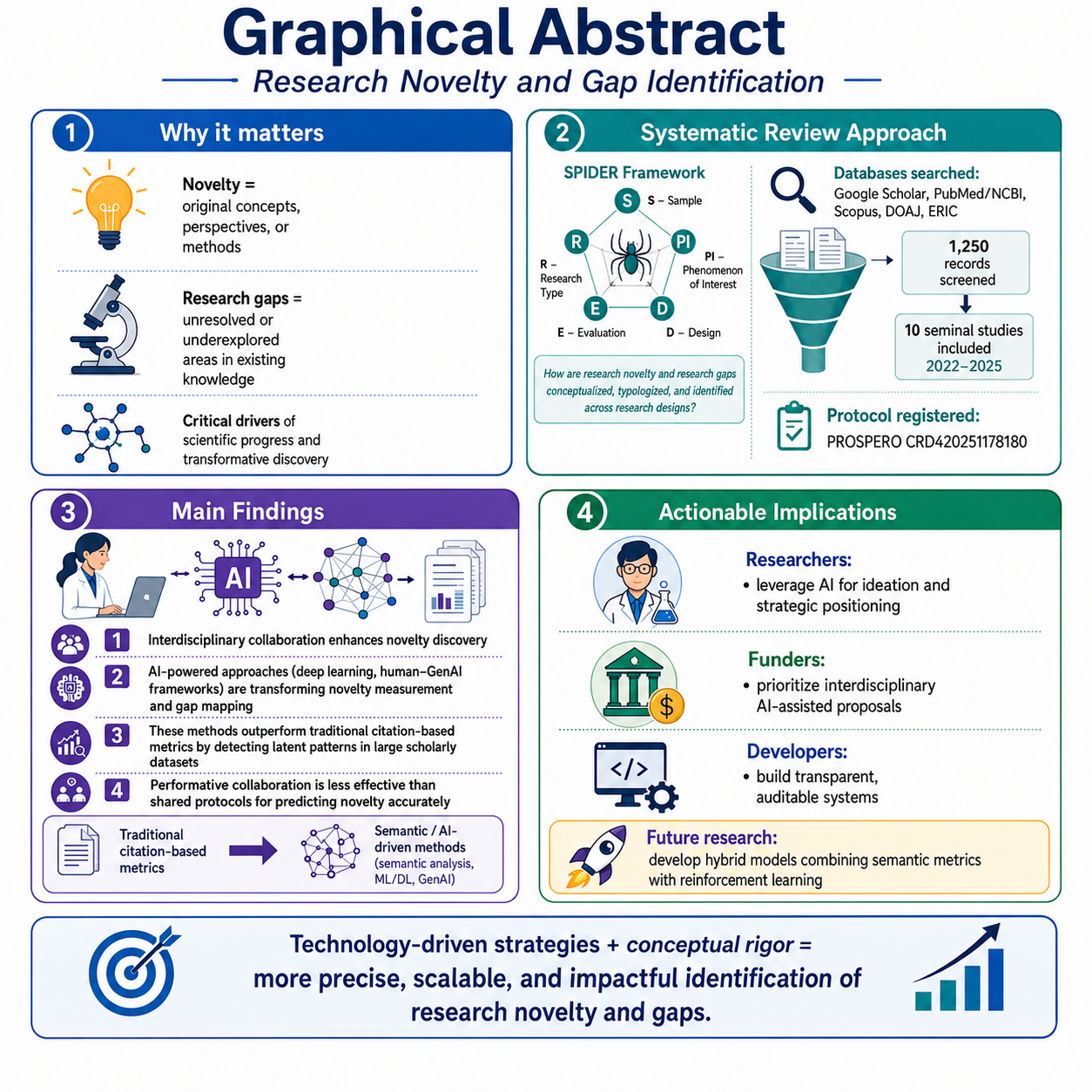
Research novelty and gap identification are critical drivers of scientific progress, enabling scholars to move beyond incremental contributions toward transformative discoveries. Novelty refers to original concepts, perspectives, or methodologies, while research gaps denote unresolved or underexplored areas within existing knowledge. This review followed the SPIDER framework (Sample, Phenomenon of Interest, Design, Evaluation, Research Type) to structure the search strategy. The guiding question was: “What are the conceptualizations, typologies, and identifying methodologies for ‘research novelty’ and ‘research gaps’ across various designs, and how have these been qualitatively explored?”. Comprehensive searches were performed across Google Scholar, PubMed/NCBI, Scopus, DOAJ, and ERIC. From 1,250 screened records, 10 seminal studies (2022–2025) were included based on relevance and quality. The protocol was registered with PROSPERO CRD420251178180. Findings reveal that interdisciplinary collaboration and AI-powered approaches—deep learning models and human–GenAI frameworks—are revolutionizing how novelty is measured and gaps are mapped. These advanced methods outperform citation-based metrics by autonomously detecting latent patterns in large scholarly datasets, offering precision and scalability. By integrating technology-driven strategies with conceptual rigor, this study provides actionable insights for researcher, and policymakers to strategically position research for maximum impact. Furthermore, performative collaboration, characterized by a lack of genuine integration, proves less effective than shared protocols for accurately predicting novelty. Future research should focus on developing hybrid models that combine semantic metrics with reinforcement learning approaches. To advance these goals, researchers should leverage AI for ideation, funders must prioritize interdisciplinary AI-assisted proposals, and developers are tasked with building transparent, auditable systems.
Keywords:
Artificial Intelligence, Deep Learning, Interdisciplinary Research, Research Gaps, Research NoveltyDownloads
References
Akbari, S., Sheikhkhoshkar, M., Rahimian, F. P., El Haouzi, H. B., Najafi, M., & Talebi, S. (2024). Sustainability and building information modelling: Integration, research gaps, and future directions. Automation in Construction, 163, 105420. https://doi.org/10.1016/j.autcon.2024.105420
Baako, I., Alhassan, H., & Gidisu, P. (2022). Understanding and spotting research gaps through a systematic literature review. International Journal of Research and Innovation in Social Science, 6(3), 549-554. https://shorturl.at/KZRa5
Chen, C. C., Wung, S. F., Rozenblit, J. W., & Roveda, J. M. (2025). The Value of a Nurse-Engineer Team in Evaluating Technology for Patient Care. Critical Care Nursing Clinics of North America, 37(2), 207-216. https://doi.org/10.1016/j.cnc.2025.02.002
Choi, S., & Lim, S. (2025). Artificial Intelligence in Pediatric Nursing Care: A Bibliometric and Visualization Analysis of the Literature (2000–2024). CIN: Computers, Informatics, Nursing, 10-1097. https://doi.org/10.1097/CIN.0000000000001360
Cochrane Central Editorial Service, Palacios, C., Hernandez, J., Ajmal, A., Rodriguez, A. J., Hassan, A. Y. I., ... & Ramella-Roman, J. C. (1996). Digital health, technology‐driven or technology‐assisted interventions for the management of obesity in children and adolescents. Cochrane Database of Systematic Reviews, 2025(7). https://doi.org/10.1002/14651858.CD015968
Cohen, W. M., Nelson, R. R., & Walsh, J. P. (2002). Links and impacts: the influence of public research on industrial R&D. Management Science, 48(1), 1-23. https://doi.org/10.1287/mnsc.48.1.1.14273
Czakó, A., Potenza, M. N., Hodgins, D. C., Yu, S. M., Wu, A. M., Jiménez-Murcia, S., ... & Demetrovics, Z. (2025). Research priorities in gambling: Findings of a large-scale expert study. Journal of Behavioral Addictions, 14(3), 1222-1249. https://doi.org/10.1556/2006.2025.00072
Del Castillo, J., & Guerguerian, A. M. (2026). Navigating the Evidence Gap: Expert Consensus as a Bridge to Research in Extracorporeal Cardiopulmonary Resuscitation for Adults. Journal of the American Heart Association, 15(4), e048459. https://doi.org/10.1161/JAHA.126.048459
El Arab, R. A., Almoosa, Z., Alkhunaizi, M., Abuadas, F. H., & Somerville, J. (2025). Artificial intelligence in hospital infection prevention: an integrative review. Frontiers in Public Health, 13, 1547450. https://doi.org/10.3389/fpubh.2025.1547450
Flindris, K., Flindris, S., Nteka, F., & Kaliardas, A. (2025). Interdisciplinary Collaboration and Job Satisfaction Among Doctors and Nurses in Greek Public Hospitals: A Cross-Sectional Study. Cureus, 17(7). https://doi.org/10.7759/cureus.88712
Gasparetto, M., Narula, P., Wong, C., Ashton, J., Kammermeier, J., Pierik, M., ... & Arebi, N. (2025). Efficacy of digital health technologies in the management of inflammatory bowel disease: an umbrella review. The Lancet Digital Health, 7(5), 100843. https://doi.org/10.1016/j.landig.2024.12.007
Gogo, S., & Musonda, I. (2022). The use of the exploratory sequential approach in mixed-method research: A case of contextual top leadership interventions in construction H&S. International Journal of Environmental Research and Public Health, 19(12), 7276. https://doi.org/10.3390/ijerph19127276
Haynes-Brown, T. K. (2025). The role of sampling in an explanatory sequential mixed methods study: General applications of the transformative paradigm. Methods in Psychology, 12, 100176. https://doi.org/10.1016/j.metip.2025.100176
Hossen, M. J., Hoque, J. M. Z., Ramanathan, T. T., & Raja, J. E. (2024). Unsupervised novelty detection for time series using a deep learning approach. Heliyon, 10(3). https://doi.org/10.1016/j.heliyon.2024.e25394
Hou, H., Li, X., Song, Y. A., Ji, Y., Sun, M., Wang, D., ... & Gu, H. (2023). Effect of interactive, multimedia-based home-initiated education on preoperative anxiety inchildren and their parents: a single-center randomized controlled trial. BMC Anesthesiology, 23(1), 95. https://doi.org/10.1186/s12871-023-02055-7
Huang, S., Long, L., Zhu, Y., & Zhu, J. N. (2026). Human–GenAI collaboration across creative phases: Cognitive mechanisms shaping novelty and usefulness. International Journal of Information Management, 86, 102986. https://doi.org/10.1016/j.ijinfomgt.2025.102986
Islam, M. S., Kabir, M. N., Ghani, N. A., Zamli, K. Z., Zulkifli, N. S. A., Rahman, M. M., & Moni, M. A. (2024). Challenges and future in deep learning for sentiment analysis: a comprehensive review and a proposed novel hybrid approach. Artificial Intelligence Review, 57(3), 62. https://doi.org/10.1007/s10462-023-10651-9
James, T. G., DeJonckheere, M., & Guetterman, T. C. (2024). Integrating transformative considerations and quantitative results through a participant selection joint display in explanatory sequential mixed methods studies. Journal of Mixed Methods Research, 18(1), 14-30. https://doi.org/10.1177/15586898221149470
Jeon, D., Lee, J., Ahn, J. M., & Lee, C. (2023). Measuring the novelty of scientific publications: A fastText and local outlier factor approach. Journal of Informetrics, 17(4), 101450. https://doi.org/10.1016/j.joi.2023.101450
Jeong, H., Park, D., Ha, E. K., Kim, J. H., Shin, J., Baek, H.-S., Hwang, H., Shin, Y. H., Jee, H. M., & Han, M. Y. (2024). Efficacies of different treatment strategies for infants hospitalized with acute bronchiolitis. Clinical and Experimental Pediatrics, 67(11), 608–618. https://doi.org/10.3345/cep.2023.01676
Jusoh, A. S., Remli, M. A., Mohamad, M. S., Cazenave, T., & Fong, C. S. (2025). How generative Artificial Intelligence can transform drug discovery?. European Journal of Medicinal Chemistry, 295, 117825. https://doi.org/10.1016/j.ejmech.2025.117825
Knop, M., Mueller, M., Kaiser, S., & Rester, C. (2024). The impact of digital technology use on nurses' professional identity and relations of power: a literature review. Journal of Advanced Nursing, 80(11), 4346-4360. https://doi.org/10.1111/jan.16178
Leung, T. I., Coristine, A. J., & Benis, A. (2025). AI scribes in health care: balancing transformative potential with responsible integration. JMIR Medical Informatics, 13(1), e80898. https://doi.org/10.2196/80898
Liu, M., Bu, Y., Chen, C., Xu, J., Li, D., Leng, Y., ... & Ding, Y. (2022). Pandemics are catalysts of scientific novelty: Evidence from COVID‐19. Journal of the Association for Information Science and Technology, 73(8), 1065-1078. https://doi.org/10.1002/asi.24612
Lopez, M. (2025). From novelty to necessity: artificial intelligence in medical education. Journal of Medical Education and Curricular Development, 12, 23821205251369656. https://doi.org/10.1177/23821205251369656
Lorents, A., Ruitenberg, M. F. L., & Schomaker, J. (2023). Novelty-induced memory boosts in humans: The when and how. Heliyon, 9(3). https://doi.org/10.1016/j.heliyon.2023.e14410
Lorents, A., Ruitenberg, M. F. L., & Schomaker, J. (2023). Novelty-induced memory boosts in humans: The when and how. Heliyon, 9(3). https://doi.org/10.1016/j.heliyon.2023.e14410
Lv, J., Kim, B. G., Slowik, A., Parameshachari, B. D., Kumari, S., Chen, C. M., & Li, K. (2024). ERLNEIL-MDP: Evolutionary reinforcement learning with novelty-driven exploration for medical data processing. Swarm and Evolutionary Computation, 91, 101769. https://doi.org/10.1016/j.swevo.2024.101769
Mohammadi, F., Salimi, R., Khazaei, S., & Bijani, M. (2025). Design and psychometric testing of a moral intelligence instrument for pre-hospital emergency medical services personnel: a sequential-exploratory mixed-method study. BMC Emergency Medicine, 25(1), 13. https://doi.org/10.1186/s12873-025-01171-6
Muna, N. D. (2025). Bridging the evidence gap: research equity in conflict-affected health systems. International Journal for Equity in Health, 24(1), 293. https://doi.org/10.1186/s12939-025-02661-6
Okeke, R. C. (2025). Understanding Research Novelty and Research Gaps: Strategies for Identifying Unexplored Areas and Pioneering Innovative Contributions. Social Sciences and Education Research Review, 12(1), 126-130. https://doi.org/10.5281/zenodo.15804528
Palumbo, M. C., Farina, L., & Petti, M. (2026). Precision Medicine Through Network Language: Integrating Clinical Insight and Data Expertise. Genes, 17(4), 467. https://doi.org/10.3390/genes17040467
Quistberg, D. A., Mooney, S. J., Tasdizen, T., Arbelaez, P., & Nguyen, Q. C. (2025). Invited commentary: deep learning—methods to amplify epidemiologic data collection and analyses. American Journal of Epidemiology, 194(2), 322-326. https://doi.org/10.1093/aje/kwae215
Salter, A. J., & Martin, B. R. (2001). The economic benefits of publicly funded basic research: a critical review. Research Policy, 30(3), 509-532. https://doi.org/10.1016/S0048-7333(00)00091-3
Schlicht, L., Wendsche, J., Melzer, M., Tschetsche, L., & Rösler, U. (2025). Digital technologies in nursing: an umbrella review. International Journal of Nursing Studies, 161, 104950. https://doi.org/10.1016/j.ijnurstu.2024.104950
Shin, H., Kim, K., & Kogler, D. F. (2022). Scientific collaboration, research funding, and novelty in scientific knowledge. PLoS One, 17(7), e0271678. https://doi.org/10.1371/journal.pone.0271678
Steyn, B. (2025). Could a novelty indicator improve science?. Nature, 642(8068), 543-543. https://doi.org/10.1038/d41586-025-01882-7
Tennant, J. P., Dugan, J. M., Graziotin, D., Jacques, D. C., Waldner, F., Mietchen, D., ... & Colomb, J. (2017). A multi-disciplinary perspective on emergent and future innovations in peer review. F1000Research, 6, 1151. https://doi.org/10.12688/f1000research.12037.3
Wang, Z., Zhang, H., Chen, J., & Chen, H. (2024). An effective framework for measuring the novelty of scientific articles through integrated topic modeling and cloud model. Journal of Informetrics, 18(4), 101587. https://doi.org/10.1016/j.joi.2024.101587
Yang, J., Wei, N., Qu, Y., Hu, C., Zhang, W., Liu, L., ... & Zheng, X. (2026). Spider: a flexible and unified framework for simulating spatial transcriptomics data. Bioinformatics, 42(1), btaf562. https://doi.org/10.1093/bioinformatics/btaf562
Yardibi, F., Chen, C., Aladag, C. H., & Kose, O. (2025). Current Trends and Future Directions of Statistical Methods in Medical Research: A Scientometric Analysis. Journal of Evaluation in Clinical Practice, 31(6), e70257. https://doi.org/10.1111/jep.70257
Published
How to Cite
Issue
Section
License
Copyright (c) 2026 Malaysian Journal of Medical Research (MJMR)

This work is licensed under a Creative Commons Attribution-NonCommercial-NoDerivatives 4.0 International License.