
Guidelines to Authors

Instructions to Authors

Instructional Videos for further guidance

About MJMR

Malaysian Journal of Medical Research (MJMR) is committed to providing timely, unrestricted access to research that focuses on research and hypotheses in medicine sciences. We believe that sharing exploratory and novel research results, as well as innovative and enlightened ideas in form of official publication is very important, as this not only incites more extensive and fruitful research on these topics, but also engraves a histological hallmark in the journal. Our vision is a wide readership, global distribution, and the highest reputation for integrity. We are committed to introducing any innovation that will help researchers share information in an interdisciplinary and timely manner. Visit: https://ejournal.lucp.net/index.php/mjmr/

Authors need to fill up some forms and follow the MJMR Template to submit the Manuscript Please follow the link: https://ejournal.lucp.net/index.php/mjmr/InstructionsFormandTemplate 

Open-Access

MJMR is open access, and all articles are distributed under the terms of the CC BY-NC 4.0 license (http://creativecommons.org/licenses/by-nc-nd/4.0/). Under this license, anyone may copy, distribute, or reuse these articles for non-commercial purposes, provided the original work is properly cited. Manuscripts submitted for publication in an open access journal are subject to the same rigorous peer-review and quality control as in scholarly subscription journals.

Copyright

Starting from 2017, the copyright on all published articles will be retained with the authors unless stated otherwise. All submissions to the MJMR should contain a completed copy of signed covered letter containing the copyright agreement.

Disclaimer Statement

All articles published in MJMR represent the views and opinions of their authors, and not the views, opinions, or policies of the publisher, except where explicitly indicated. MJMR shall not be held responsible for the use of views and opinions expressed in the articles; use of any information in the articles shall not be considered an endorsement of the products advertised.

Authorship Changes Policy

Authors will not be added to or removed from articles after submission unless definitive evidence is provided to justify the request.

  • Adding Authors: Requests to add an author must be supported by clear evidence demonstrating that the individual contributed substantially to the research, writing, editing, and development of the work.
  • Removing Authors: Requests to remove an author must be accompanied by confirmation from the individual concerned, verifying that they did not participate in the research, writing, editing, or development of the work in a manner that justifies authorship recognition.

Article Types

Original Articles

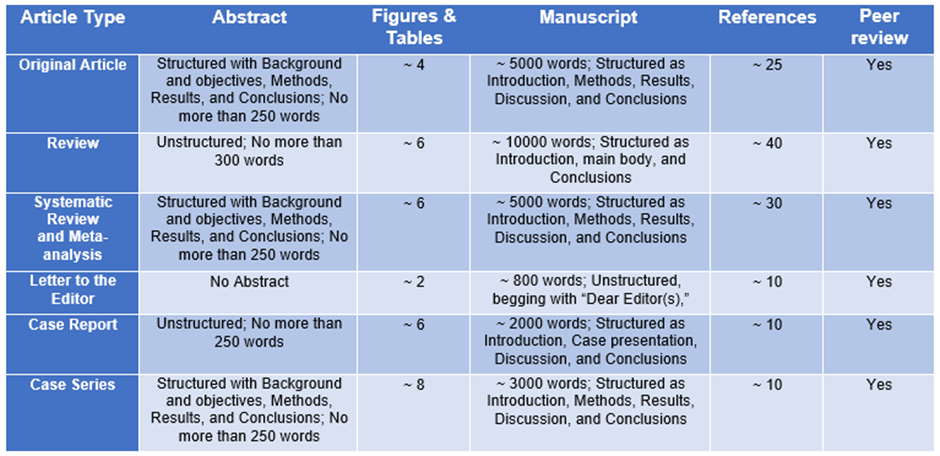
Original research manuscripts should report experimental or clinical studies in biomedicine, including exploratory and hypothesis-driven work. Data must originate from the authors’ own research and be supported by appropriate statistical analysis. Authors should follow relevant reporting guidelines and submit the corresponding checklist.

Manuscript requirements: Length: ~4000 words, References: ~25, Figures/Tables: ~4

Structure: Title page, Structured Abstract (Background/Objectives, Methods, Results, Conclusions; max 250 words), Keywords (3-5), Introduction, Methodology (include applied guideline), Results, Discussion, Conclusions, Conflict of Interest, Acknowledgement, References.

Review Articles

Review manuscripts should summarize recent advances or challenges in a specific biomedical field, offering new insights, hypotheses, or recommendations for future research. Visual aids (figures, diagrams, tables) are strongly encouraged. A Methods section is only required if the focus is methodological.

Manuscript requirements: Length: ~5000 words, References: ~40, Figures/Tables: ~6

Structure: Title page, Abstract (unstructured, single paragraph, ≤300 words), Keywords (3–5), Introduction, Viewpoints (subsections), Conflict of Interest, Acknowledgement, Conclusions, References.

Systematic Reviews & Meta-analyses

Systematic reviews must follow explicit methods (Cochrane definition) to identify, appraise, and synthesize relevant studies based on a clearly defined PICOS (Population, Interventions, Comparators, Outcomes, Study designs). Meta-analyses may be included but are not mandatory. These articles are categorized as Original Articles. Reports must adhere to PRISMA guidelines, include a flow diagram, and submit the completed PRISMA checklist.

Manuscript requirements: Length: ~5000 words, References: ~30, Figures/Tables: ~6

Structure:Title page, Structured Abstract (Background/Objectives, Methods, Results, Conclusions; ≤250 words), Keywords (3-5), Introduction, Methodology, Results, Discussion, Conflict of Interest, Acknowledgement, Conclusions, References.

Letters to the Editor

Letters should address timely issues related to previously published articles, offering constructive, professional comments, insights, or updates supported by current literature.

Manuscript requirements: Length: ~800 words, References: ~10, Figures/Tables: ~2

Structure: Title page, Main Text (addressed to the Editor), Declarations, ReferencesNo abstract required.

Case Reports

Case Reports describe 1–3 patients with rare or unexpected conditions providing significant clinical or biomedical insights. Reports should include background (from medical records and literature) and obtain written patient consent.

Manuscript requirements: Length: ~2000 words, References: ~10, Figures/Tables: ~2-6

Structure: Title page, Abstract (unstructured, ≤250 words), Keywords, Introduction, Case Presentation, Discussion, Conflict of Interest, Acknowledgement, Conclusions, References.

Case Series

Case Series (≥4 patients) follow the same structure as an Original Article.

Manuscript requirements: Length: ~3000 words, References: ~10, Figures/Tables: ~8

Structure: Title page, Abstract (unstructured, ≤250 words), Keywords, Introduction, Case Presentation, Discussion, Conflict of Interest, Acknowledgement, Conclusions, References 

CRediT Author Statement: An Author Declaration is a mandatory part of a submission.

Recognizing individual authors' contributions, minimizing authorship disputes, and promoting collaboration are all made possible through CRediT (Contributor Roles Taxonomy). This is necessary following collaborative workshops on multi-author publications developed under the Welcome Trust with input from researchers. CRediT offers authors the opportunity to share an accurate and detailed description of their diverse contributions to the published work.

Giving credit gives authors the chance to accurately and fully describe the contributions of each author made towards the publication of the work. The descriptions must be accurate and approved by all authors, and that responsibility is with the corresponding author. Using the pertinent categories list the role(s) played by each author. Multiple roles may have been played by the authors. The requirements for authorship in the journal remain the same regardless of credit.

In this manner the corresponding author should take responsibility for the integrity of the work as a whole. Credit statements should be provided during the submission process and will appear above the acknowledgement section.

Example: Gulnur Yildiz: Conceptualization, Methodology, Software. Richard Avagu.: Data curation, Writing- Original draft preparation. Amos Andoono: Visualization, Investigation. Dominic Nyarko: Supervision.: Saviour Kofi Katamani: Software, Validation. Ini Edeh: Writing- Reviewing and Editing.

Term Definition
Conceptualization Ideas: formulation or evolution of overarching research goals and aims
Methodology Development or design of methodology; creation of models
Software Programming, software development; designing computer programs; implementation of the computer code and supporting algorithms; testing of existing code components
Validation Verification, whether as a part of the activity or separate, of the overall replication/ reproducibility of results/experiments and other research outputs
Formal analysis Application of statistical, mathematical, computational, or other formal techniques to analyse or synthesize study data
Investigation Conducting a research and investigation process, specifically performing the experiments, or data/evidence collection
Resources Provision of study materials, reagents, materials, patients, laboratory samples, animals, instrumentation, computing resources, or other analysis tools
Data Curation Management activities to annotate (produce metadata), scrub data and maintain research data (including software code, where it is necessary for interpreting the data itself) for initial use and later reuse
Writing – Original Draft Preparation, creation and/or presentation of the published work, specifically writing the initial draft (including substantive translation)
Writing – Review & Editing Preparation, creation and/or presentation of the published work by those from the original research group, specifically critical review, commentary, or revision – including pre-or post-publication stages
Visualization Preparation, creation and/or presentation of the published work, specifically visualization/ data presentation
Supervision Oversight and leadership responsibility for the research activity planning and execution, including mentorship external to the core team
Project administration Management and coordination responsibility for the research activity planning and execution
Funding acquisition Acquisition of the financial support for the project leading to this publication

Acknowledgement: All contributors who do not meet the criteria for authorship should be covered in the acknowledgement section. It should include persons who provided technical help, writing assistance and departmental head that only provided general support. Financial and material support should also be acknowledged.

Author(s) must acknowledge and declare any sources of funding and potential conflicting interest, such as receiving funds or fees by, holding stocks and shares in and organizations that may profit or lose through publication of your paper. Declaring a competing interest will not lead to automatic rejection of the paper, but we would like to be made aware of it.

Manuscript Preparation: Structure of Article and Author Guidelines

  • General Information:
    1. Please write your article in good English (We are following US English from 01.09.2025).
    2. Articles must be submitted online or as an email attachment to: info@mjmr.com.my.
    3. Articles (including the references) should have the following specifications:
      1. Text document must be in Microsoft Word compatible format and in one style column with 2 cm, margin at each side of A4 paper.
      2. Body text must be double-spaced, in font size 12pt and Times New Roman.
  • Heading must be font size 16pt, in bold and Times New Roman.
  • Subheading must be font size 14pt, in bold and Times New Roman.
  • Plagiarism- All articles will be checked for plagiarism. If plagiarism is found, the article will be rejected.
  • The AI (Artificial Intelligence) should not exceed 20%.
  • Title: The first letter of each word in the title should be typed in capital letters. Please avoid using punctuation marks like (,), (“ “), ( ? ), ( ! ), etc. in the title and don’t underline words (Font: Arial, Style: Bold, Size: 14).
  • Authors’ Names: Please write authors’ names after the main topic (Font: Arial, Style: Bold, Size: 11). The number of authors should not be more than 6.
  • Please indicate authors’ postal addresses completely after their names. Country name, telephone number and email addresses of each author are necessary (Font: Arial, Style: Italic, Size: 11).
  • Abstract: Abstract should be less than 250 words. Authors need to be careful that the abstract reflects the content of the article accurately (Font: Arial, Style: Normal, Size: 12).
  • Keywords: Indicate keywords after abstract (3-4words). Please separate your keywords with (;) (Font: Arial, Style: Normal, Size: 10).
  • Note: The Articles in the following parts:
    1. Title Page
    2. Title of article.
  • The full name/s of the authors.
  • Job title/Occupation, employer, location and affiliation of each author.
  • Name and address of the author responsible for correspondence (Include address, telephone number and email adder (Font: Arial, Style: Bold, Size: 12).
  • Tables: Present tables in appropriate places in the article. Number tables in accordance with their appearance in the text. Place the caption of the table above the table. Place explanatory matters below the table. Avoid vertical rules (Font: Arial, Style: Normal, Size: 10 - both caption and data in table).
  • Figures: Present figures at the end of the article. Number figures in accordance with their appearance in the text. Place the caption of figures and diagrams below them (Font: Arial, Style: Normal, Size: 10 - for captions and data in diagrams and figures)
  • References:Use the APA Referencing Guide. Arrange references alphabetically at the end of the article. https://apastyle.apa.org/style-grammar-guidelines/references/examples
  • Font: Arial, Style: Normal, Size: 10
  • All the references must be in English (not translated) with a DOI link within the time period of 5 years.
  • Ensure that 75% of your references are drawn from sources published within 10 years.
  • Acknowledgements: This section should acknowledge any personal assistance and providers of special reagents from sources that do not fulfil the requirements of authorship; individuals’ names and affiliations should be provided in full. The names of individuals who provided writing assistance (in full and with affiliations, if applicable) should be given in this section.
  • Conflict of Interest: Author(s) declare any sources of funding and potential conflicting interest, such as receiving funds or fees, holding stocks and shares in and organizations that may profit or lose through publication of your paper. Declaring a competing interest will not lead to automatic rejection of the paper, but we would like to be made aware of it.
  • Ethical Statement: All studies involving human subjects or animals should include a clear ethical statement that includes the name of the institution that provided Ethical Approval, the date of the Ethical Approval, and the Ethical Approval number.

Submission Manuscripts must be written in English (US English - We are following US English from 01.09.2025). Also, the manuscript must have a confirmation letter that assumes manuscripts are exclusively submitted to MJMR and have not been previously published elsewhere (except in the form of an abstract or as part of a published lecture, review or thesis) and are not under consideration by any other journal. In the covering letter, one author should be specified as the "corresponding author", and all other authors should personally sign the covering letter. Authors are responsible for all statements made in their work. The editorial board has the right to insert any necessary changes so that the manuscript is harmonized with the editorial framework of the journal. All submissions to the MJMR should contain a completed copy of a signed covered letter containing the copyright agreement.Final Checklist: The authors must ensure that before submitting the manuscript for publication, they have taken care of the following:

  • Title page should contain title, name of the author(s), their qualifications, mailing address for future correspondence, email address, phone and fax number.
  • Abstract in structured format up to 250 words.
  • Keywords contain 3-5 words.
  • References should be typed as instruction that mentioned above.
  • Tables and figures should be typed at the end of the article.

Please refer to our Instructional Videos for guidance on the submission process.Copyright (covering) Letter. (COPYRIGHT TRANSFER AGREEMENT)