Knowledge, Attitude and Practice Regarding Telemedicine among People Attending a Tertiary Care Hospital in Eastern India
DOI:
https://doi.org/10.31674/mjmr.2026.v010i02.09Abstract
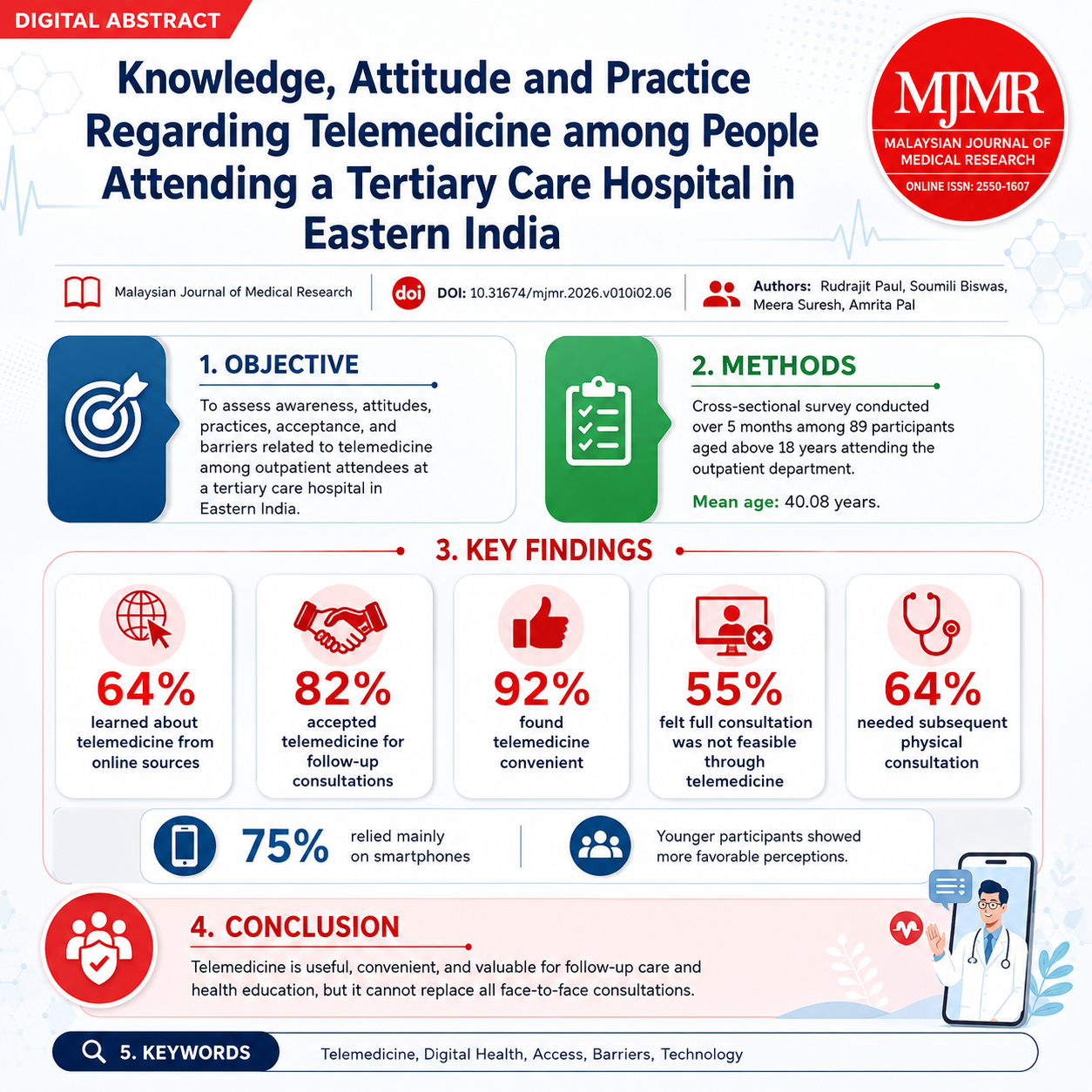
Background: Telemedicine has emerged as an important innovation in healthcare delivery, improving access to medical services, particularly in geographically underserved areas. The increasing availability of mobile devices and internet connectivity has further supported its expansion and helped reduce the burden on resource-constrained healthcare systems. Objectives: This study aimed to assess the knowledge, attitudes, and practices related to telemedicine among outpatient department attendees at a tertiary care hospital in Eastern India. It also sought to evaluate users’ awareness, understanding, proficiency, perceived challenges, and acceptance of telemedicine services. Methods: A cross-sectional survey was conducted over five months among 89 participants aged above 18 years attending the outpatient department. Data were collected to assess awareness, attitudes, utilization practices, and barriers related to telemedicine. The mean age of participants was 40.08 years. Results: Telemedicine awareness was mainly derived from online sources. Most participants accepted telemedicine for follow-up consultations, with 82% expressing acceptance and 92% finding it convenient. However, 55% felt that a full consultation was not feasible through telemedicine. A majority of participants required subsequent physical consultations. Younger participants showed more favorable perceptions toward telemedicine compared with older individuals. Conclusion: Although telemedicine cannot address all healthcare needs, it has an important role in providing medical care and health education. When integrated into an established patient–doctor relationship, telemedicine can serve as an efficient, convenient, and valuable mode of healthcare delivery.
Keywords:
Access, Barriers, Digital Health, Technology, TelemedicineDownloads
References
Al Hinnawi, S. (2024). Evaluation of the knowledge, perception, and willingness towards telemedicine among healthcare workers in Mumbai. International Journal of Life Science, Biotechnology and Pharma Research, 13(1), 221–227. https://ijlbpr.com/uploadfiles/37vol13issue1pp221-227.20240123044506.pdf
Ashfaq, A., Memon, S. F., Zehra, A., Barry, S., Jawed, H., Akhtar, M., Kirmani, W., Malik, F., Khawaja, A. W., Barry, H., Saiyid, H., Farooqui, N., Khalid, S., Abbasi, K., & Siddiqi, R. (2020). Knowledge and attitude regarding telemedicine among doctors in Karachi. Cureus, 12(2), e6927. https://doi.org/10.7759/cureus.6927
Ashwood, J. S., Mehrotra, A., Cowling, D., & Uscher-Pines, L. (2017). Direct-to-consumer telehealth may increase access to care but does not decrease spending. Health Affairs, 36(3), 485-491. https://doi.org/10.1377/hlthaff.2016.1130
Butzner, M., & Cuffee, Y. (2021). Telehealth interventions and outcomes across rural communities in the United States: narrative review. Journal of Medical Internet Research, 23(8), e29575. https://doi.org/10.2196/29575
Cochran, W. G. (1977). Sampling techniques (3rd ed.). John Wiley & Sons.
Dhilawala, R., Assi, F. a. A., Elmahi, A., Ali, A. a. A., Abushairah, S., Alnakhi, W. K., Shorbagi, A., & Hussein, A. (2026). Knowledge, Attitudes, and Practices toward Telemedicine among Physicians in the United Arab Emirates: A Cross-Sectional Study. Cureus, 18(4), e107199. https://doi.org/10.7759/cureus.107199
Dwivedi, R., Bohra, G., Bhardwaj, A., Goel, A. D., Choudhary, B., Sharma, P. P., Dwivedi, P., Singh, S., Singh, P., & Singh, K. (2024). Provider’s satisfaction with telemedicine services for tribals of Western Rajasthan: A qualitative analysis. Journal of Family Medicine and Primary Care, 13(5), 1708–1714. https://doi.org/10.4103/jfmpc.jfmpc_1241_23
Galle, A., Semaan, A., Huysmans, E., Audet, C., Asefa, A., Delvaux, T., Afolabi, B. B., El Ayadi, A. M., & Benova, L. (2021). A double-edged sword-telemedicine for maternal care during COVID-19: Findings from a global mixed-methods study of healthcare providers. BMJ Global Health, 6(2), e004575. https://doi.org/10.1136/bmjgh-2020-004575
Goyal, A., & Khatib, M. N. (2022). Knowledge, attitude and practice regarding telemedicine among health professionals involved in treating patient attending a rural tertiary care hospital in central India: a cross sectional study. Journal of Research Medical and Dental Science, 10(12), 247-258. https://www.jrmds.in/articles/knowledge-attitude-and-practice-regarding-telemedicine-among-health-professionals-involved-in-treating-patient-attending-a-rural-t-95677.html
Haleem, A., Javaid, M., Singh, R. P., & Suman, R. (2021). Telemedicine for healthcare: Capabilities, features, barriers, and applications. Sensors International, 2, 100117. https://doi.org/10.1016/j.sintl.2021.100117
Haque, M. M. A., Jahan, Y., Khair, Z., Moriyama, M., Rahman, M. M., Sarker, M. H. R., Shaima, S. N., Chowdhury, S., Matin, K. F., Karim, I. J., Ahmed, M. T., Hossain, S. Z., Masud, M. A. H., Nabi, M. G., Aziz, A. B., Sharif, M., Chowdhury, M. F. I., Shams, K. L., Nizam, N. B., … Hawlader, M. D. H. (2022). Perceptions about telemedicine among populations with chronic diseases amid COVID-19: Data from a cross-sectional survey. International Journal of Environmental Research and Public Health, 19(7), 4250. https://doi.org/10.3390/ijerph19074250
Hemalatha, S., Adavala, K. M., Kumar, P. S., Muthuvairavan Pillai, N., Muruganandam, S., & Krishna Mohan, G. (2026). Telemedicine Growth: A Comparative Study of Global and Indian Scenarios. Telehealth and Medicine Today, 11, 10-30953. https://doi.org/10.30953/thmt.v11.620
Institute of Medicine (US) Committee on Evaluating Clinical Applications of Telemedicine. (1996). Introduction and background. In M. J. Field (Ed.), Telemedicine: A guide to assessing telecommunications in health care. National Academies Press. https://doi.org/10.17226/5296
Joshi, A., Kale, S., Chandel, S., & Pal, D. K. (2015). Likert Scale: Explored and Explained. Current Journal of Applied Science and Technology, 7(4), 396–403. https://doi.org/10.9734/BJAST/2015/14975
Kruse, C. S., Karem, P., Shifflett, K., Vegi, L., Ravi, K., & Brooks, M. (2018). Evaluating barriers to adopting telemedicine worldwide: a systematic review. Journal of telemedicine and telecare, 24(1), 4-12. https://doi.org/10.1177/1357633X16674087
Lei, S., & Jiang, S. (2026). eHealth literacy and eHealth usage among older adults in Singapore: The roles of attitudes and social norms. Health Communication, 41(5), 911-920. https://doi.org/10.1080/10410236.2025.2538729
Ministry of Health and Family Welfare, Government of India (MoHFW). (2020). Telemedicine practice guidelines. New Delhi, India: Ministry of Health and Family Welfare. https://esanjeevani.mohfw.gov.in/assets/guidelines/Telemedicine_Practice_Guidelines.pdf
Mishra, S. K., Ayyagari, A., Bhandari, M., Bedi, B. S., & Shah, R. (2004). Telemedicine application in Maha Kumbh Mela (Indian festival) with large congregation. Telemedicine Journal and e-Health, 10 (Suppl 1), S107–S108.
Mishra, S. K., Singh, I. P., & Chand, R. D. (2012). Current status of telemedicine network in India and future perspective. Proceedings of the Asia-Pacific Advanced Network, 32(1), 151-163. http://journals.sfu.ca/apan/index.php/apan/article/view/54
Murshidi, R., Hammouri, M., Taha, H., Kitaneh, R., Alshneikat, M., Al-Qawasmeh, A., ... & Al-Ani, A. (2022). Knowledge, attitudes, and perceptions of Jordanians toward adopting and using telemedicine: national cross-sectional study. JMIR Human Factors, 9(4), e41499. https://doi.org/10.2196/41499
Naing, L., Winn, T. B. N. R., & Rusli, B. N. (2006). Practical issues in calculating the sample size for prevalence studies. Archives of orofacial Sciences, 1, 9-14. https://sl1nk.com/70i6sqq
Pradhan, N., Panda, N., Singh, S., Rout, M. R., & Samantaray, K. (2022). Knowledge, attitude and perception of health care providers and their patients regarding “Telemedicine” for otorhinolaryngeal care during the COVID-19 pandemic. International Journal of Community Medicine and Public Health, 9(12), 4499. https://doi.org/10.18203/2394-6040.ijcmph20223205
Rankja, S., Makwana, B., Shringarpure, K., Rankja, D., & Rankja, D. (2026). Knowledge and practice of telemedicine among healthcare professionals at a tertiary care hospital in Western India: A cross-sectional study. International Journal of Innovative Science and Research Technology, 11(2), 2078–2084. https://doi.org/10.38124/ijisrt/26feb903
Rosh, P. S. N., Lal, S. S., Lopez, S., & Mini, G. K. (2025). Current pattern of use and barriers to implementation of eSanjeevani telemedicine services in Kerala, India. International Journal of Community Medicine and Public Health, 12(10), 4572–4580. https://www.ijcmph.com/index.php/ijcmph/article/view/1432
Ryu, S. (2012). Telemedicine: opportunities and developments in member states: report on the second global survey on eHealth 2009 (global observatory for eHealth series, volume 2). Healthcare Informatics Research, 18(2), 153. https://doi.org/10.4258/hir.2012.18.2.153
Whittington, J. R., Ramseyer, A. M., & Taylor, C. B. (2020). Telemedicine in Low-Risk. Telemedicine and Connected Health in Obstetrics and Gynecology, An Issue of Obstetrics and Gynecology Clinics, 47(2), 241. https://doi.org/10.1016/j.ogc.2020.02.006
World Health Organization. (2018). WHO guidelines on translation and adaptation of instruments. World Health Organization. https://apps.who.int/iris/handle/10665/43796
World Health Organization. (2021). Global strategy on digital health 2020–2025. World Health Organization. https://www.who.int/publications/i/item/9789240020924
Zhang, B., Li, L., Lu, Y., Salmon, J. B., Stetson, R. L., Horst, M. A., ... & Chen, Y. (2026). Episode charges and subsequent visits after telemedicine vs in-person care. JAMA Network Open, 9(2), e2556127. https://doi.org/10.1001/jamanetworkopen.2025.56127
Published
How to Cite
Issue
Section
License
Copyright (c) 2026 Malaysian Journal of Medical Research (MJMR)

This work is licensed under a Creative Commons Attribution-NonCommercial-NoDerivatives 4.0 International License.