Parallel Use of Traditional and Allopathic Medicine: Pathways to Integrative Healthcare
DOI:
https://doi.org/10.31674/mjmr.2026.v010i03.04Abstract
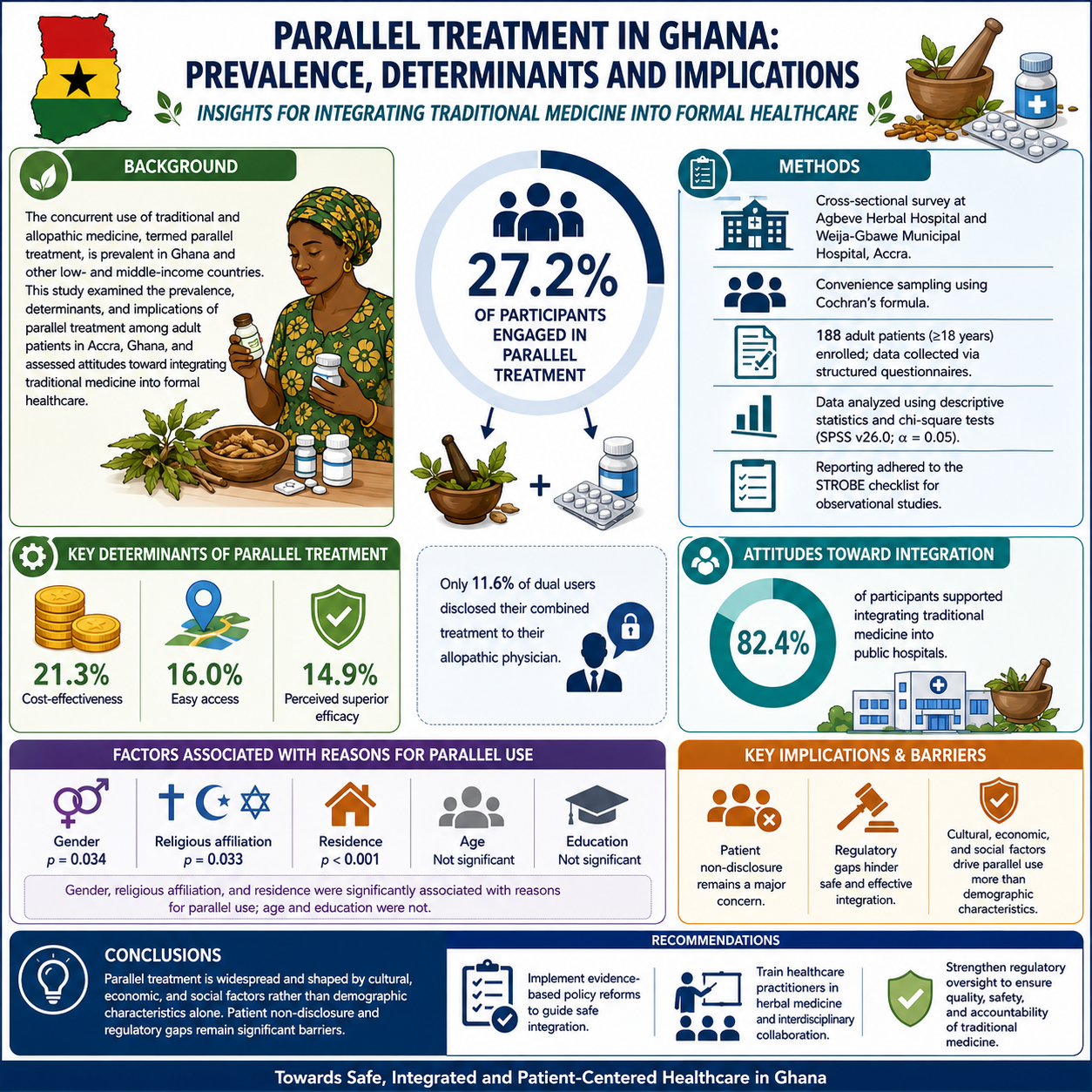
Background: The concurrent use of traditional and allopathic medicine, termed parallel treatment, is prevalent in Ghana and other low- and middle-income countries. This study examined the prevalence, determinants, and implications of parallel treatment among adult patients in Accra, Ghana, and assessed attitudes toward integrating traditional medicine into formal healthcare. Methods: A cross-sectional survey was conducted at Agbeve Herbal Hospital and Weija-Gbawe Municipal Hospital, Accra. Using convenience sampling and Cochran’s formula, 188 adult patients (≥18 years) were enrolled. Data were collected via structured questionnaires and analyzed using descriptive statistics and chi-square tests (SPSS v26.0; α = 0.05). Reporting adhered to the STROBE checklist for observational studies. Results: 27.2% of participants engaged in parallel treatment. Key determinants included cost-effectiveness (21.3%), easy access (16.0%), and perceived superior efficacy (14.9%). Only 11.6% of dual users disclosed their combined treatment to their allopathic physician. Gender (p = 0.034), religious affiliation (p = 0.033), and residence (p < 0.001) were significantly associated with reasons for parallel use; age and education were not. 82.4% of participants supported integrating traditional medicine into public hospitals. Conclusions: Parallel treatment is widespread and shaped by cultural, economic, and social factors rather than demographic characteristics alone. Patient non-disclosure and regulatory gaps remain significant barriers. Evidence-based policy reforms, practitioner training in herbal medicine, and strengthened regulatory oversight are needed to facilitate safe, integrated healthcare delivery in Ghana.
Keywords:
Parallel treatment, traditional medicine, allopathic medicine, healthcare integration, public health, GhanaDownloads
References
Al-Worafi, Y. M., & Ming, L. C. (2022). Attitude and practice of Yemeni physicians toward the integration of herbal medicines into patient care practice. https://doi.org/10.21203/rs.3.rs-2351211/v1
Ameade, E. P. K., Ibrahim, M., Ibrahim, H. S., Habib, R. H., & Gbedema, S. Y. (2018). Concurrent use of herbal and orthodox medicines among residents of Tamale, Northern Ghana, who patronize hospitals and herbal clinics. Evidence-Based Complementary and Alternative Medicine, 2018(1), 1289125. https://doi.org/10.1155/2018/1289125
Ampomah, I. G., Ampomah, G. A., & Emeto, T. I. (2024). Integrating modern and herbal medicines in controlling malaria: experiences of orthodox healthcare providers in Ghana. Archives of Public Health, 82(1), 240. https://doi.org/10.1186/s13690-024-01472-5
Ampomah, I. G., Malau-Aduli, B. S., Seidu, A. A., Malau-Aduli, A. E., & Emeto, T. I. (2022). The practice of integrated healthcare and the experiences of people in Ghana’s Ashanti region. BMC Health Services Research, 22(1), 32. https://doi.org/10.1186/s12913-021-07340-0
Asante, E., & Avornyo, R. (2013). Enhancing healthcare system in Ghana through integration of traditional medicine. Journal of Social Research, 4(2). http://dx.doi.org/10.5296/jsr.v4i2.4224
Aziato, L., & Antwi, H. O. (2016). Facilitators and barriers of herbal medicine use in Accra, Ghana: an inductive exploratory study. BMC Complementary and Alternative Medicine, 16(1), 142. https://doi.org/10.1186/s12906-016-1124-y
Balneaves, L. G., Weeks, L., & Seely, D. (2008). Patient decision-making about complementary and alternative medicine in cancer management: context and process. Current Oncology, 15(Suppl 2), s94. https://doi.org/10.3747/co.v15i0.280
Chahrour, J. A., Abdel Baki, Z., El Badan, D., Nasser, G., Maresca, M., & Hijazi, A. (2025). Herbal Medicines in the Management of Diabetes Mellitus: Plants, Bioactive Compounds, and Mechanisms of Action. Biomolecules, 15(12), 1674. https://doi.org/10.3390/biom15121674
Cochran, W.G. (1977) Sampling Techniques. 3rd Edition, John Wiley & Sons, New York. - References
- Scientific Research Publishing [Internet]. [cited 2023 Aug 8]. https://www.scirp.org/(S(i43dyn45teexjx455qlt3d2q))/reference/ReferencesPapers.aspx?Refe renceID=1390266
Ekor, M. (2014). The growing use of herbal medicines: issues relating to adverse reactions and challenges in monitoring safety. Frontiers in Pharmacology, 4, 177. https://doi.org/10.3389/fphar.2013.00177
Grimes, D. A., & Schulz, K. F. (2002). An overview of clinical research: the lay of the land. The Lancet, 359(9300), 57-61. https://doi.org/10.1016/S0140-6736(02)07283-5
Gumede, L. (2026). Addressing communication dynamics in traditional medicine use disclosure to physicians. African Journal of Primary Health Care & Family Medicine, 18(1), 5177. https://journals.co.za/doi/abs/10.4102/phcfm.v18i1.5177
Hughes, G. D., Aboyade, O. M., Hill, J. D., & Rasu, R. S. (2015). The role and importance of economic evaluation of traditional herbal medicine use for chronic non-communicable diseases. Comparative Effectiveness Research, 49-55. https://doi.org/10.2147/CER.S77163
Kwame, A. (2021). Integrating traditional medicine and healing into the Ghanaian mainstream health system: voices from within. Qualitative Health Research, 31(10), 1847-1860. https://doi.org/10.1177/10497323211008849
Lunyera, J., Wang, D., Maro, V., Karia, F., Boyd, D., Omolo, J., ... & Comprehensive Kidney Disease Assessment For Risk factors, epidemiology, Knowledge, and Attitudes (CKD AFRiKA) Study. (2016). Traditional medicine practices among community members with diabetes mellitus in Northern Tanzania: an ethnomedical survey. BMC Complementary and Alternative Medicine, 16(1), 282. https://doi.org/10.1186/s12906-016-1262-2
Moebus, S., Lehmann, N., Bödeker, W., & Jöckel, K. H. (2006). An analysis of sickness absence in chronically ill patients receiving complementary and alternative medicine: a longterm prospective intermittent study. BMC Public Health, 6(1), 28. https://doi.org/10.1186/1471-2458-6-28
Nezenega, Z. S., Gacho, Y. H. M., & Tafere, T. E. (2013). Patient satisfaction on tuberculosis treatment service and adherence to treatment in public health facilities of Sidama zone, South Ethiopia. BMC Health Services Research, 13(1), 110. https://doi.org/10.1186/1472-6963-13-110
Robinson, A., & McGrail, M. R. (2004). Disclosure of CAM use to medical practitioners: a review of qualitative and quantitative studies. Complementary Therapies in Medicine, 12(2-3), 90-98. https://doi.org/10.1016/j.ctim.2004.09.006
Sedgwick P. (2010). Cross sectional studies: advantages and disadvantages. BMJ. 348. https://doi.org/10.1136/bmj.g2276
Shelley, B. M., Sussman, A. L., Williams, R. L., Segal, A. R., & Crabtree, B. F. (2009). ’They don’t ask me so I don’t tell them’: Patient-clinician communication about traditional, complementary, and alternative medicine. The Annals of Family Medicine, 7(2), 139-147. https://doi.org/10.1370/afm.947
Udonwa, N. E., & Ogbonna, U. K. (2012). Patient-Related Factors Inf luencing Satisfaction in the Patient-Doctor Encounters at the General Outpatient Clinic of the University of Calabar Teaching Hospital, Calabar, Nigeria. International Journal of Family Medicine, 2012(1), 517027. https://doi.org/10.1155/2012/517027
Van Rooyen, D., Pretorius, B., Tembani, N. M., & Ten Ham, W. (2015). Allopathic and traditional health practitioners' collaboration. Curationis, 38(2), 1-10.
https://doi.org/10.4102/CURATIONIS.v38i2.1495
Weeks, L., Balneaves, L. G., Paterson, C., & Verhoef, M. (2014). Decision-making about complementary and alternative medicine by cancer patients: integrative literature review. Open Medicine, 8(2), e54.
Xia, X., May, B. H., Zhang, A. L., Guo, X., Lu, C., Xue, C., & Huang, Q. (2020). Chinese herbal medicines for rheumatoid arthritis: Text-mining the classical literature for potentially effective natural products. Evidence-Based Complementary and Alternative Medicine, 2020(1), 7531967. https://doi.org/10.1155/2020/7531967
Published
How to Cite
Issue
Section
License
Copyright (c) 2026 Malaysian Journal of Medical Research (MJMR)

This work is licensed under a Creative Commons Attribution-NonCommercial-NoDerivatives 4.0 International License.