Endovascular Balloon Occlusion in the Management of an Iatrogenic Superficial Femoral Artery Pseudoaneurysm
DOI:
https://doi.org/10.31674/mjmr.2026.v010i03.02Abstract
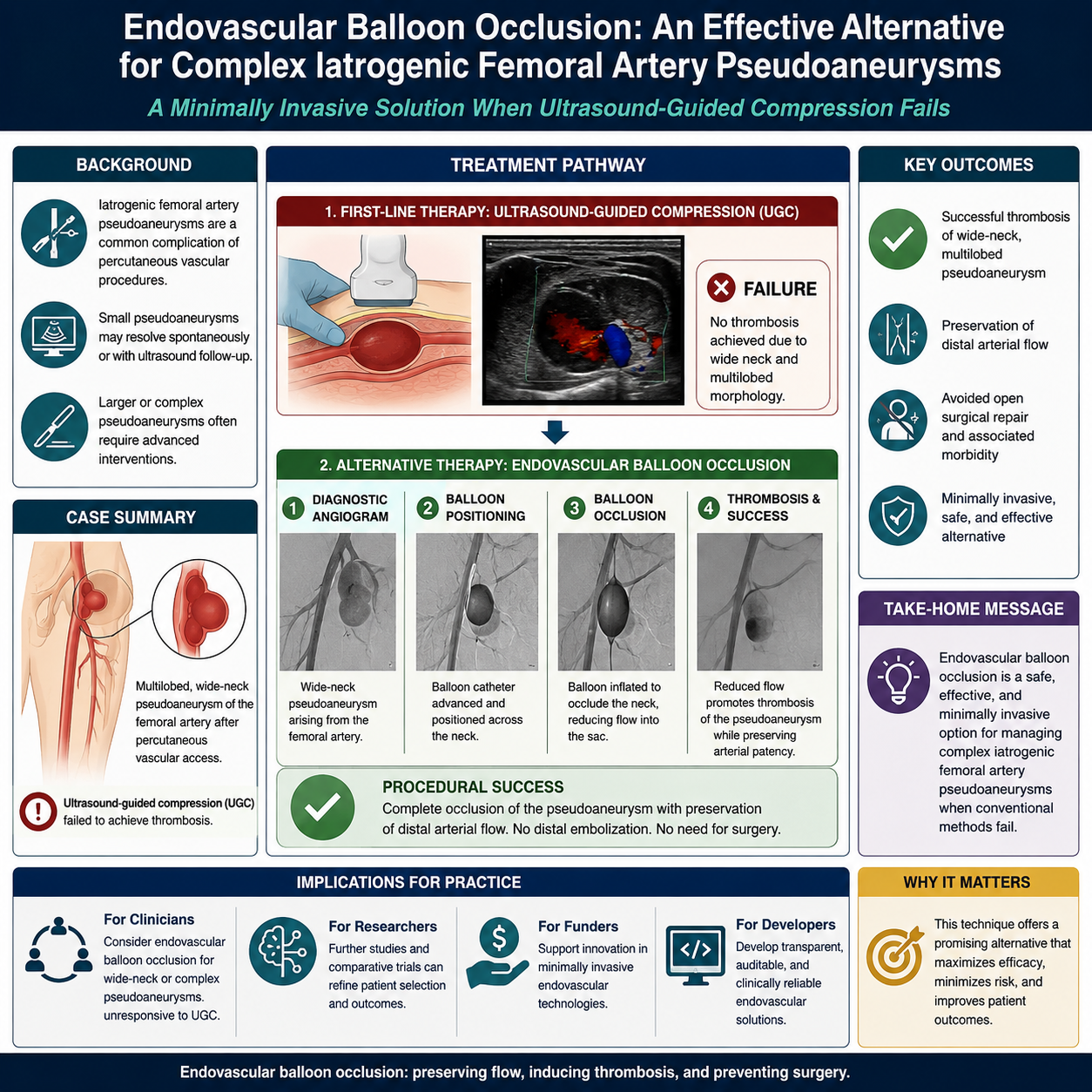
Iatrogenic arterial injuries, especially those leading to pseudoaneurysms, are common complications following percutaneous vascular access and interventional procedures. While small pseudoaneurysms may resolve spontaneously or be managed conservatively with observation and serial ultrasound follow-ups, larger or more complex pseudoaneurysms often require more advanced interventions. Ultrasound-guided compression (UGC) is a widely used first-line treatment due to its simplicity, non-invasive nature, and cost-effectiveness. However, its success is limited, particularly in the case of wide-neck pseudoaneurysms, as seen in this report. In a case where UGC failed to achieve thrombosis in a multilobed, wide-neck pseudoaneurysm, endovascular balloon occlusion was employed. This technique involved temporarily inflating a balloon at the pseudoaneurysm neck, effectively reducing blood flow to the sac and promoting thrombosis. The procedure successfully occluded the pseudoaneurysm, minimizing the risk of distal embolization and preventing the need for open surgical repair. This minimally invasive approach offers a promising alternative for the management of iatrogenic femoral artery pseudoaneurysms, particularly when conventional methods fail. The technique not only avoids the risks associated with surgery but also demonstrates a high level of efficacy in inducing thrombosis, ensuring the preservation of distal arterial flow and avoiding significant morbidity. This case underscores the utility of endovascular balloon occlusion in treating complex pseudoaneurysms and highlights its potential as a preferred method in certain clinical settings.
Keywords:
Endovascular balloon occlusion, Pseudoaneurysm, Superficial femoral arteryDownloads
References
Dzijan-Horn, M., Langwieser, N., Groha, P., Bradaric, C., Linhardt, M., Böttiger, C., ... & Ibrahim, T. (2014). Safety and efficacy of a potential treatment algorithm by using manual compression repair and ultrasound-guided thrombin injection for the management of iatrogenic femoral artery pseudoaneurysm in a large patient cohort. Circulation: Cardiovascular Interventions, 7(2), 207-215. https://doi.org/10.1161/CIRCINTERVENTIONS.113.000836
Griviau, L., Chevallier, O., Marcelin, C., Nakai, M., Pescatori, L., Galland, C., ... & Loffroy, R. (2018). Percutaneous ultrasound-guided balloon-assisted embolization of iatrogenic femoral artery pseudoaneurysms with Glubran® 2 cyanoacrylate glue: safety, efficacy and outcomes. Quantitative Imaging in Medicine and Surgery, 8(8), 796. https://doi.org/10.21037/qims.2018.09.12
Ibrahim, K., Christoph, M., Wunderlich, C., Jellinghaus, S., Loehn, T., Youssef, A., ... & Pfluecke, C. (2012). A novel interventional method for treating femoral pseudoaneurysms (Vol. 31, No. 6, pp. 579-85). EIJ-D-16-00865. https://doi.org/10.4244/EIJ-D-16-00865
Le, T. D., Than, V. S., & Nguyen, M. D. (2021). Percutaneous balloon-assisted ultrasound-guided direct glue embolization of deep femoral artery pseudoaneurysm rupture. Radiology Case Reports, 16(3), 425-429. https://doi.org/10.1016/j.radcr.2020.12.018
Mazurkiewicz, K., Kruszyna, Ł., & Krasiński, Z. (2024). Etiology and management of iatrogenic femoral pseudoaneurysm. Acta Angiologica, 30(3), 112-120. https://doi.org/10.5603/aa.101863
Toursarkissian, B., Allen, B. T., Petrinec, D., Thompson, R. W., Rubin, B. G., Reilly, J. M., ... & Sicard, G. A. (1997). Spontaneous closure of selected iatrogenic pseudoaneurysms and arteriovenous fistulae. Journal of Vascular Surgery, 25(5), 803-809. https://doi.org/10.1016/s0741-5214(97)70209-x
Published
How to Cite
Issue
Section
License
Copyright (c) 2026 Malaysian Journal of Medical Research (MJMR)

This work is licensed under a Creative Commons Attribution-NonCommercial-NoDerivatives 4.0 International License.