Trimester-wise UTI Prevalence and Associated Risk Factors among Pregnant Women in Bangladesh
DOI:
https://doi.org/10.31674/mjmr.2026.v010i03.03Abstract
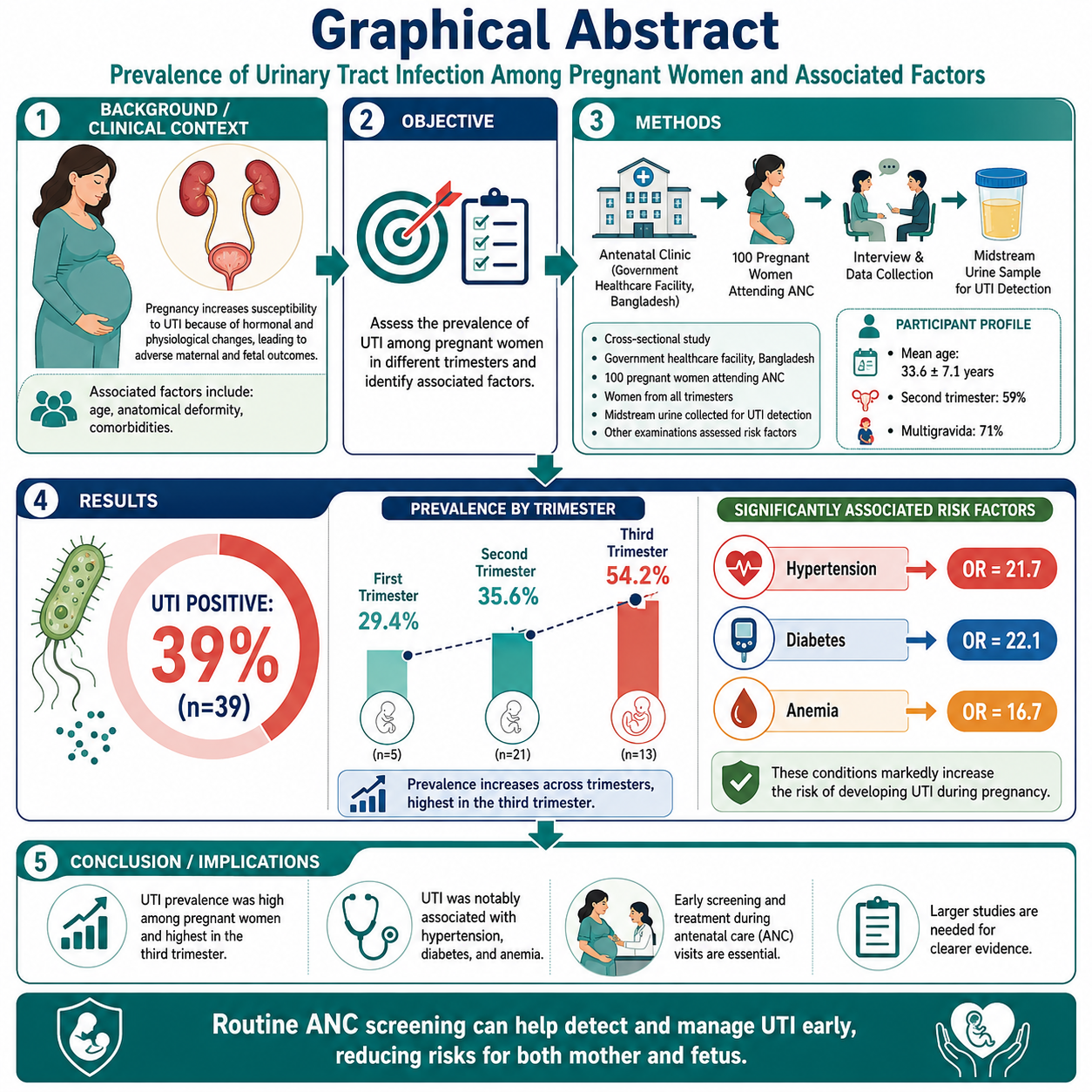
Background: Urinary Tract Infection (UTI) susceptibility increases during pregnancy due to hormonal and physiological changes and resulting multiple adverse outcomes for both mother and fetus. Several factors are associated with this infection, including age, anatomical deformity, and comorbidities. Objectives: Assessing the prevalence of UTI among pregnant women in different trimesters and associated factors. Methods: This is a cross-sectional study conducted in a government healthcare facility of Bangladesh. Pregnant women attending for ante-natal check-up were interviewed after taking consent. A total of 100 pregnant ladies from different trimesters participated in this study. Midstream urine was collected to detect UTI and other examinations were done to find out associated risk factors. Results: The mean age of the respondents was 33.6 (±7.1) years, and most of them (n=59, 59%) were in their second trimester, and (n=71, 71%) were multigravida. Among the participants, 39% (n=39) were tested positive for UTI. The prevalence of UTI in the first trimester was 29.4% and increased in the second and trimester and the prevalences were 35.6% and 54.2%, respectively. A statistically significant association was found between UTI and risk factors like hypertension (OR=21.7), diabetes (OR=22.1), and anemia (OR=16.7) which increase the risk of developing UTI manifolds during pregnancy. Conclusion: A higher prevalence of UTI was found among pregnant women, and mostly in their third trimester. A notable association was found between UTI and certain risk factors, emphasizing the early screening and treatment for UTI during antenatal care (ANC) visits. A study with a larger sample may give a clearer image.
Keywords:
Co-morbidities, Pregnancy, Risk Factors, UTIDownloads
References
Akhter, P., Habiba, Z., & Walida, S. A. (2024). Mst. Shabrin Akhter, Sharmin Sultana, Masuda Sultana (2024). Risk factors of UTI in pregnant women and the maternal and perinatal outcome. Saudi Journal of Medicine, 9(12), 541-546. https://doi.org/10.36348/sjm.2024.v09i12.004
Al Haddad, A. M. (2005). Urinary tract infection among pregnant women in Al Mukalla district, Yemen. EMHJ-Eastern Mediterranean Health Journal, 11(3), 505-510, 2005. https://pesquisa.bvsalud.org/portal/resource/pt/emr-66867
Al-Bash, M. R., Mathew, M., Al-Kharusi, L. A., & Abu-Heija, A. T. (2016). Symptomatic urinary tract infection in diabetic pregnant women, effect of the type of diabetes and glycemic control. Saudi Journal of Medicine & Medical Sciences, 4(2), 104-107. https://doi.org/10.4103/1658-631X.178327
Ashshi, A. M., Faidah, H. S., Saati, A. A., El-Ella, G. A. A., Al-Ghamdi, A. K., & Mohamed, A. M. (2013). Urinary tract infections in pregnant women, assessment of associated risk factors in Makkah, KSA. Biosciences Biotechnology Research Asia, 10(1). http://dx.doi.org/10.13005/bbra/1091
Bembalagi, S., & Sojitra, M. P. (2018). Study of relationship between anemia and urinary tract infection in pregnant women. Al Ameen Journal of Medical Science, 11(1), 71-5. https://www.scribd.com/document/611482294/2
Chu, C. M., & Lowder, J. L. (2018). Diagnosis and treatment of urinary tract infections across age groups. American Journal of Obstetrics and Gynecology, 219(1), 40-51. https://doi.org/10.1016/j.ajog.2017.12.231
Colgan, R., Nicolle, L. E., McGlone, A., & Hooton, T. M. (2006). Asymptomatic bacteriuria in adults. American Family Physician, 74(6), 985-990. https://www.aafp.org/pubs/afp/issues/2006/0915/p985.html
Habak, P. J., Carlson, K., & Griggs Jr, R. P. (2024). Urinary tract infection in pregnancy. In StatPearls [Internet]. StatPearls Publishing. https://www.statpearls.com/nursepractitioner/ce/activity/97826/?utm_source=chatgpt.com
Haider, G., Zehra, N., Munir, A. A., & Haider, A. (2010). Risk factors of urinary tract infection in pregnancy. JPMA. The Journal of the Pakistan Medical Association, 60(3), 213. https://shorturl.at/lohMj
Islam, M. M., & Masud, M. S. (2018). Determinants of frequency and contents of antenatal care visits in Bangladesh: Assessing the extent of compliance with the WHO recommendations. PloS One, 13(9), e0204752. https://doi.org/10.1371/journal.pone.0204752
Jeyabalan, A., & Lain, K. Y. (2007). Anatomic and functional changes of the upper urinary tract during pregnancy. Urologic Clinics, 34(1), 1-6. https://doi.org/10.1016/j.ucl.2006.10.008
Lee, A. C., Mullany, L. C., Koffi, A. K., Rafiqullah, I., Khanam, R., Folger, L. V., ... & Baqui, A. H. (2019). Urinary tract infections in pregnancy in a rural population of Bangladesh: population-based prevalence, risk factors, etiology, and antibiotic resistance. BMC Pregnancy and Childbirth, 20(1), 1. https://doi.org/10.1186/s12884-019-2665-0
Marlina, D., Utomo, A., Adriansyah, P. N. A., Pelitawati, D. R., Poernomo, M. A. B. P. D., Sumawan, H., ... & Aziz, M. A. (2025). Association of bacteriuria with hypertension risk in pregnant women. Medical Science Monitor: International Medical Journal of Experimental and Clinical Research, 31, e946167. https://doi.org/10.12659/MSM.946167
Minardi, D., d’Anzeo, G., Cantoro, D., Conti, A., & Muzzonigro, G. (2011). Urinary tract infections in women: etiology and treatment options. International Journal of General Medicine, 333-343. https://doi.org/10.2147/IJGM.S11767
Ngong, I. N., Fru-Cho, J., Yung, M. A., & Akoachere, J. F. K. T. (2021). Prevalence, antimicrobial susceptibility pattern and associated risk factors for urinary tract infections in pregnant women attending ANC in some integrated health centers in the Buea Health District. BMC Pregnancy and Childbirth, 21(1), 673. https://doi.org/10.1186/s12884-021-04142-4
Okonko, I. O., Ijandipe, L. A., Ilusanya, O. A., Donbraye-Emmanuel, O. B., Ejembi, J., Udeze, A. O., ... & Nkang, A. O. (2009). Incidence of urinary tract infection (UTI) among pregnant women in Ibadan, South-Western Nigeria. African Journal of Biotechnology, 8(23). https://doi.org/10.4314/ajb.v8i23.66370
Parveen, K., Momen, A., Begum, A. A., & Begum, M. (2011). Prevalence of urinary tract infection during pregnancy. Journal of Dhaka National Medical College & Hospital, 17(2), 8-12. https://doi.org/10.3329/jdnmch.v17i2.12200
Ranjan, A., Sridhar, S. T. K., Matta, N., Chokkakula, S., & Ansari, R. K. (2017). Prevalence of UTI among pregnant women and its complications in newborns. Indian Journal of PharmacyPractice, 10(1). https://doi.org/10.5530ijopp.10.1.10
Rodriguez-Mañas, L. (2020). Urinary tract infections in the elderly: a review of disease characteristics and current treatment options. Drugs in Context, 9. https://doi.org/10.7573/dic.2020-4-13
Salari, N., Khoshbakht, Y., Hemmati, M., Khodayari, Y., Khaleghi, A. A., Jafari, F., ... & Mohammadi, M. (2023). Global prevalence of urinary tract infection in pregnant mothers: a systematic review and meta-analysis. Public Health, 224, 58-65. https://doi.org/10.1016/j.puhe.2023.08.016
Shahreen, H. (2020). Risk factors of UTI in pregnant women and the maternal and perinatal outcome in pregnant women. British Journal of Medical & Health Sciences (BJMHS), 19, 260-266. https://www.jmhsci.org/wp-content/uploads/2020/11/BJMHS450200.pdf
Taye, S., Getachew, M., Desalegn, Z., Biratu, A., & Mubashir, K. (2018). Bacterial profile, antibiotic susceptibility pattern and associated factors among pregnant women with Urinary Tract Infection in Goba and Sinana Woredas, Bale Zone, Southeast Ethiopia. BMC research notes, 11(1), 799. https://doi.org/10.1186/s13104-018-3910-8
Tynan, S., Phelps, C., & Moro, C. (2026). Patient education for preventing recurrent urinary tract infections (UTIs): a systematic review. Patient Education and Counseling, 109557. https://doi.org/10.1016/j.pec.2026.109557
Wang, E., Tang, P., & Chen, C. (2024). Urinary tract infections and risk of preterm birth: a systematic review and meta-analysis. Revista do Instituto de Medicina Tropical de São Paulo, 66, e54. https://doi.org/10.1590/S1678-9946202466054
World Health Organization. (2023). WHO recommendations on antenatal care for a positive pregnancy experience: screening, diagnosis and treatment of tuberculosis disease in pregnant women. Evidence-to-action brief: Highlights and key messages from the World Health Organization’s 2016 global recommendations. World Health Organization.
Yan, L., Jin, Y., Hang, H., & Yan, B. (2018). The association between urinary tract infection during pregnancy and preeclampsia: A meta-analysis. Medicine, 97(36), e12192. https://doi.org/10.1097/MD.0000000000012192
Yefet, E., Bejerano, A., Iskander, R., Zilberman Kimhi, T., & Nachum, Z. (2023). The association between gestational diabetes mellitus and infections in pregnancy—systematic review and meta-analysis. Microorganisms, 11(8), 1956. https://doi.org/10.3390/microorganisms11081956
Published
How to Cite
Issue
Section
License
Copyright (c) 2026 Malaysian Journal of Medical Research (MJMR)

This work is licensed under a Creative Commons Attribution-NonCommercial-NoDerivatives 4.0 International License.